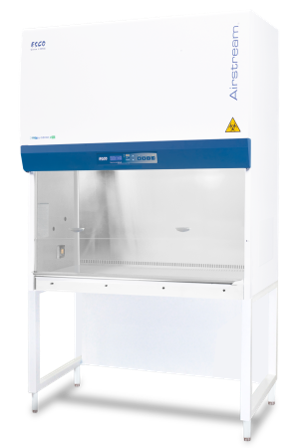
Biologinės saugos spinta (BSC) daugiausia naudojama patogeniniams biologiniams mėginiams tvarkyti arba taikymo srityse, kuriose reikalinga sterili darbo zona. Biologinės saugos spinta sukuria įtekantį ir žemyn nukreiptą oro srautą, užtikrinantį operatoriaus apsaugą. Žemyn nukreiptas oro srautas praeina pro ULPA / HEPA filtrą ir sukuria ISO 3 klasės darbo zoną, apsaugančią mėginius nuo kryžminio užteršimo rizikos. Išpučiamas oras prieš išleidžiant taip pat praeina pro ULPA / HEPA filtrą, kad būtų apsaugota aplinka.
Esco biologinės saugos spintos turi platų pasirinkimų spektrą: nuo darbinių padėklų ir šoninių panelių konstrukcijos iki priedų. Esco BSC sukurtos su ergonomiškomis ir energiją taupančiomis funkcijomis.
Siekiant užtikrinti optimalų biologinės saugos spintos veikimą, jos išbandomos ir klasifikuojamos pagal 2 standartus: EN 12469:2000 ir NSF 49.

EN 12469
EN 12469: 2000 Biotechnologija. Mikrobiologinių saugos spintų eksploataciniai kriterijai yra naujas suderintas Europos standartas, skirtas mikrobiologinėms saugos spintoms, kurį išleido CEN, Europos standartizacijos komitetas. Šis standartas klasifikuoja BSC į I klasę, II klasę ir III klasę.

NSF
NSF International (anksčiau – The National Sanitation Foundation) biologinės saugos spintų programa buvo inicijuota 1970-aisiais reguliavimo institucijų, įskaitant Ligų kontrolės centrus (CDC), Nacionalinius sveikatos institutus (NIH) ir Nacionalinį vėžio institutą (NCI), prašymu. Šis standartas papildomai klasifikuoja II klasės biologinės saugos spintas pagal potipius, remiantis oro cirkuliacija: II klasės A1 tipą, II klasės A2 tipą, II klasės B1 tipą ir II klasės B2 tipą.
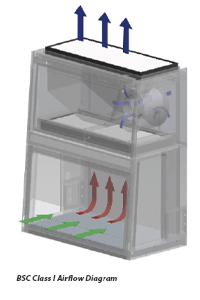
A Class I Biosafety cabinet protects the operator and the environment from exposure to biohazards. It does not prevent samples being handled in the cabinet from being exposed to contaminants that may be present in room air. Naturally, there is a possibility of cross-contamination that may affect experimental consistency. Consequently, the scope and application of Class I cabinets is limited, and it is largely considered obsolete.
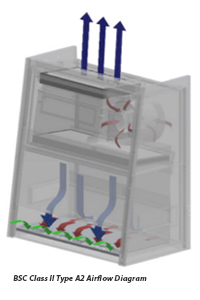
Class II Type A2
The Class II Type A2 biological safety cabinet is the most common Class II cabinet. It has a plenum from which 30% of air is exhausted, and 70% re-circulated to the work area as the downflow.
Stated from NSF/ ANSI 49:2010, both the Class II Type A1 and Type A2 must have the positively-pressurized contaminated plenum to be surrounded by negative pressure. In case there is a leakage on the positive plenum, the leaking aerosol will be pulled by the negative pressure back to the positive plenum, and it will not leak out.
In the A2 cabinet, about 70% of air from the positive plenum is recirculated as downflow, and the remaining 30% is discharged to the lab through the exhaust filter.
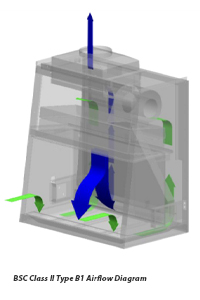
Class II Type B1
The Class II Type B1 biological safety cabinet has a common plenum from which 70% of air is exhausted, and 30% re-circulated to the work area as the downflow. This cabinet also has a dedicated exhaust feature that eliminates re-circulation when work is performed towards the back within the interior of the cabinet. Toxic chemicals employed as an adjunct to microbiological processes should only be allowed if they do not interfere with work when re-circulated in the downflow.
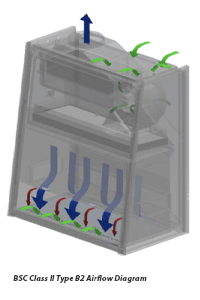
Class II Type B2
The Class II Type B2 biosafety cabinets are suitable for work with toxic chemicals employed as an adjunct to microbiological processes under all circumstances since no re-circulation occurs. In theory, Type B2 biological safety cabinets may be considered as the safest of all Class II BSCs since the total exhaust feature acts as a fail-safe in the event that the downflow and / or exhaust HEPA filtration systems cease to function normally. However, Class II Type B2 biosafety cabinets require large laboratory spaces due to their installation system and will require elaborate ducting works.
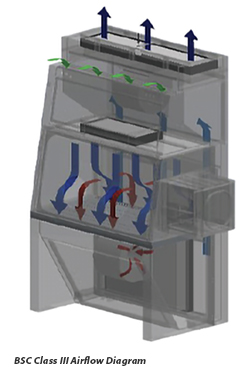
Class III Biological Safety Cabinets (BSCs) are designed for work involving microbiological agents assigned to Biosafety Levels 1, 2, 3, and 4, and are commonly specified for applications involving highly hazardous biological agents.
All work is performed through glove ports located at the front of the cabinet, ensuring complete physical separation between the operator and the work area. During normal operation, the cabinet maintains negative pressure relative to the surrounding environment. The cabinet is equipped with dual HEPA filtration on the exhaust system to provide an additional level of protection for personnel and the surrounding environment.
Pagal PSO laboratorijų biologinio saugumo vadovo 4-ąjį leidimą, konkretaus scenarijaus faktinei rizikai įtakos turi ne tik naudojamas veiksnys, bet ir atliekama procedūra bei laboratorinėje veikloje dalyvaujančio personalo kompetencija.
Rizikos grupės yra klasifikacijos, apibūdinančios santykinį pavojų, kurį laboratorijoje kelia infekciniai veiksniai arba toksinai.
Pasaulio sveikatos organizacija (PSO) rizikos grupes apibrėžia taip:
- PSO 1 rizikos grupė – nėra individualios ir visuomeninės rizikos arba ji maža
- PSO 2 rizikos grupė – vidutinė individuali rizika, maža visuomeninė rizika
- PSO 3 rizikos grupė – didelė individuali rizika, maža visuomeninė rizika
- PSO 4 rizikos grupė – didelė individuali ir visuomeninė rizika
Biologinės saugos spintos persertifikuojamos kasmet ir (arba) kaskart, kai yra perkeliamos.
Pagal PSO laboratorijų biologinio saugumo vadovo 3-iąjį leidimą, dauguma BSC yra suprojektuotos taip, kad galėtų veikti 24 val./parą. Nustatyta, kad nepertraukiamas veikimas padeda kontroliuoti dulkių ir kietųjų dalelių kiekį laboratorijoje.
Numatomas HEPA arba ULPA filtrų galiojimo laikas tinkamai laikant yra iki 10 metų.
Filtrai turėtų būti laikomi originalioje pakuotėje ir neturėtų būti veikiami drėgmės, per didelio karščio, šalčio ar greitai kintančios temperatūros. Šie filtrai gali atlaikyti iki 95% drėgmę; bet kokia didesnė drėgmė gali užkimšti filtro medžiagą ir sukelti jos gedimą.