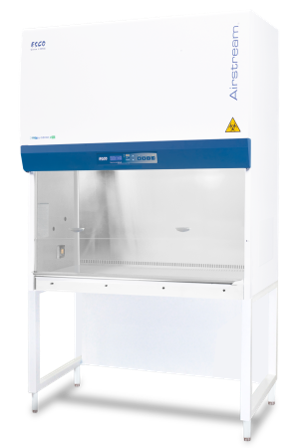
Uma Cabine de Segurança Biológica (CSB), também conhecida como cabine de biossegurança, é usada principalmente para o manuseio de amostras biológicas patogênicas ou para aplicações que exigem uma zona de trabalho estéril. Uma cabine de segurança biológica cria um fluxo de ar de entrada e descendente que oferece proteção ao operador. O fluxo de ar descendente passa por um filtro ULPA/HEPA e cria uma zona de trabalho ISO Classe 3 para proteger as amostras do risco de contaminação cruzada. O ar exaurido também passa por um filtro ULPA/HEPA antes da liberação para proteger o meio ambiente.
As cabines de segurança biológica da Esco têm uma ampla gama de opções, desde bandejas de trabalho e construção de painéis laterais até acessórios. As CSBs da Esco são projetadas com recursos ergonômicos e de economia de energia.
Para garantir o desempenho ideal da cabine de segurança biológica, elas são testadas e classificadas por 2 normas: EN 12469:2000 e NSF 49.

EN 12469
A EN 12469: 2000 Biotecnologia - Critérios de desempenho para cabines de segurança biológica é a nova norma europeia harmonizada para cabines de segurança biológica, publicada pelo CEN, o Comitê Europeu de Normalização. Esta norma classifica as CSBs em Classe I, Classe II e Classe III.

NSF
O Programa de Cabines de Segurança Biológica da NSF International (anteriormente The National Sanitation Foundation) foi iniciado durante a década de 1970 a pedido da comunidade reguladora, incluindo os Centers for Disease Control (CDC), National Institutes of Health (NIH) e o National Cancer Institute (NCI). Esta norma classifica ainda as Cabines de Segurança Biológica Classe II de acordo com subtipos baseados na circulação de ar: Classe II Tipo A1, Classe II Tipo A2, Classe II Tipo B1 e Classe II Tipo B2.
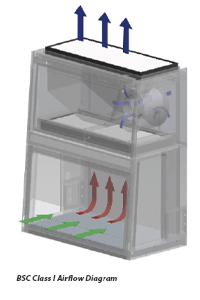
A Class I Biosafety cabinet protects the operator and the environment from exposure to biohazards. It does not prevent samples being handled in the cabinet from being exposed to contaminants that may be present in room air. Naturally, there is a possibility of cross-contamination that may affect experimental consistency. Consequently, the scope and application of Class I cabinets is limited, and it is largely considered obsolete.
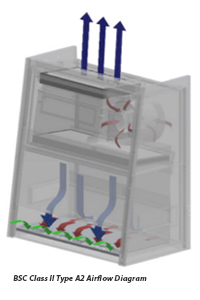
Class II Type A2
The Class II Type A2 biological safety cabinet is the most common Class II cabinet. It has a plenum from which 30% of air is exhausted, and 70% re-circulated to the work area as the downflow.
Stated from NSF/ ANSI 49:2010, both the Class II Type A1 and Type A2 must have the positively-pressurized contaminated plenum to be surrounded by negative pressure. In case there is a leakage on the positive plenum, the leaking aerosol will be pulled by the negative pressure back to the positive plenum, and it will not leak out.
In the A2 cabinet, about 70% of air from the positive plenum is recirculated as downflow, and the remaining 30% is discharged to the lab through the exhaust filter.
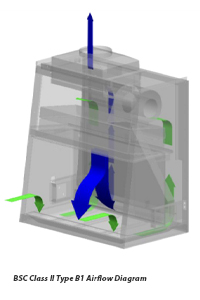
Class II Type B1
The Class II Type B1 biological safety cabinet has a common plenum from which 70% of air is exhausted, and 30% re-circulated to the work area as the downflow. This cabinet also has a dedicated exhaust feature that eliminates re-circulation when work is performed towards the back within the interior of the cabinet. Toxic chemicals employed as an adjunct to microbiological processes should only be allowed if they do not interfere with work when re-circulated in the downflow.
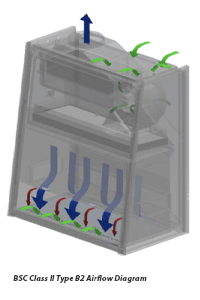
Class II Type B2
The Class II Type B2 biosafety cabinets are suitable for work with toxic chemicals employed as an adjunct to microbiological processes under all circumstances since no re-circulation occurs. In theory, Type B2 biological safety cabinets may be considered as the safest of all Class II BSCs since the total exhaust feature acts as a fail-safe in the event that the downflow and / or exhaust HEPA filtration systems cease to function normally. However, Class II Type B2 biosafety cabinets require large laboratory spaces due to their installation system and will require elaborate ducting works.
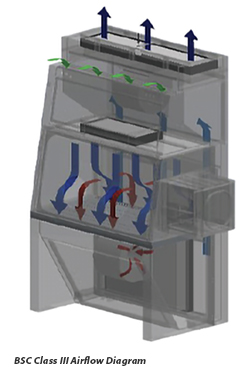
Class III Biological Safety Cabinets (BSCs) are designed for work involving microbiological agents assigned to Biosafety Levels 1, 2, 3, and 4, and are commonly specified for applications involving highly hazardous biological agents.
All work is performed through glove ports located at the front of the cabinet, ensuring complete physical separation between the operator and the work area. During normal operation, the cabinet maintains negative pressure relative to the surrounding environment. The cabinet is equipped with dual HEPA filtration on the exhaust system to provide an additional level of protection for personnel and the surrounding environment.
De acordo com o Manual de Biossegurança Laboratorial da OMS, 4ª edição, o risco real de um determinado cenário é influenciado não apenas pelo agente que está sendo manuseado, mas também pelo procedimento que está sendo realizado e pela competência do pessoal do laboratório envolvido na atividade laboratorial.
Grupos de Risco são classificações que descrevem o perigo relativo apresentado por agentes infecciosos ou toxinas no laboratório.
A Organização Mundial da Saúde (OMS) define os grupos de risco como:
- Grupo de Risco 1 da OMS- nenhum ou baixo risco individual e comunitário
- Grupo de Risco 2 da OMS- risco individual moderado, baixo risco comunitário
- Grupo de Risco 3 da OMS- alto risco individual, baixo risco comunitário
- Grupo de Risco 4 da OMS- alto risco individual e comunitário
As cabines de segurança biológica são recertificadas anualmente e/ou sempre que forem movimentadas.
De acordo com o Manual de biossegurança laboratorial da OMS, 3ª edição, a maioria das CSBs é projetada para permitir a operação 24 h/dia. Constatou-se que a operação contínua ajuda a controlar os níveis de poeira e materiais particulados no laboratório.
A vida útil estimada dos filtros HEPA ou ULPA é de até 10 anos quando armazenados adequadamente.
Os filtros devem ser mantidos em suas embalagens originais e não devem ser expostos à umidade, calor excessivo, frio ou variações rápidas de temperatura. Esses filtros podem tolerar até 95% de umidade; qualquer valor superior pode fazer com que o meio filtrante bloqueie e falhe.