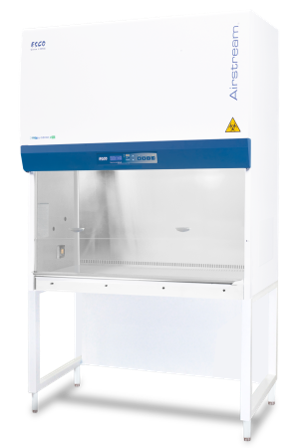
En mikrobiologisk säkerhetsbänk (BSC) används huvudsakligen för hantering av patogena biologiska prover eller för användningsområden som kräver en steril arbetszon. En mikrobiologisk säkerhetsbänk skapar ett inflöde och nedåtriktat luftflöde som ger operatörsskydd. Det nedåtriktade luftflödet passerar genom ett ULPA/HEPA-filter och skapar en arbetszon i ISO-klass 3 för att skydda prover från risken för korskontaminering. Frånluften passerar också genom ett ULPA/HEPA-filter före utsläpp för att skydda miljön.
Escos säkerhetsbänkar har ett brett utbud av tillval, från arbetsbrickor och sidopanelskonstruktion till tillbehör. Escos mikrobiologiska säkerhetsbänkar är utformade med ergonomiska och energibesparande egenskaper.
För att garantera den mikrobiologiska säkerhetsbänkens optimala prestanda testas och klassificeras dessa enligt 2 standarder: EN 12469:2000 och NSF 49.

EN 12469
EN 12469: 2000 Bioteknik – Prestandakriterier för mikrobiologiska säkerhetsbänkar är den nya harmoniserade europeiska standarden för mikrobiologiska säkerhetsbänkar, publicerad av CEN, den europeiska standardiseringskommittén. Denna standard klassificerar säkerhetsbänkar i klass I, klass II och klass III.

NSF
NSF Internationals (tidigare The National Sanitation Foundation) program för mikrobiologiska säkerhetsbänkar initierades under 1970-talet på begäran av tillsynsmyndigheter, inklusive Centers for Disease Control (CDC), National Institutes of Health (NIH) och National Cancer Institute (NCI). Denna standard klassificerar vidare mikrobiologiska säkerhetsbänkar i klass II i undertyper baserade på luftcirkulation: klass II typ A1, klass II typ A2, klass II typ B1 och klass II typ B2.
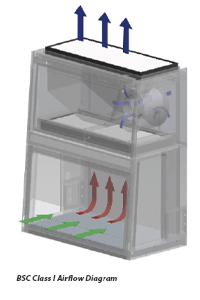
A Class I Biosafety cabinet protects the operator and the environment from exposure to biohazards. It does not prevent samples being handled in the cabinet from being exposed to contaminants that may be present in room air. Naturally, there is a possibility of cross-contamination that may affect experimental consistency. Consequently, the scope and application of Class I cabinets is limited, and it is largely considered obsolete.
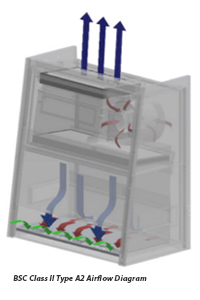
Class II Type A2
The Class II Type A2 biological safety cabinet is the most common Class II cabinet. It has a plenum from which 30% of air is exhausted, and 70% re-circulated to the work area as the downflow.
Stated from NSF/ ANSI 49:2010, both the Class II Type A1 and Type A2 must have the positively-pressurized contaminated plenum to be surrounded by negative pressure. In case there is a leakage on the positive plenum, the leaking aerosol will be pulled by the negative pressure back to the positive plenum, and it will not leak out.
In the A2 cabinet, about 70% of air from the positive plenum is recirculated as downflow, and the remaining 30% is discharged to the lab through the exhaust filter.
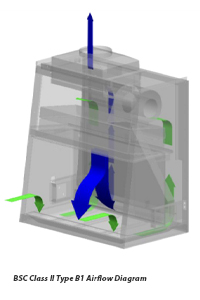
Class II Type B1
The Class II Type B1 biological safety cabinet has a common plenum from which 70% of air is exhausted, and 30% re-circulated to the work area as the downflow. This cabinet also has a dedicated exhaust feature that eliminates re-circulation when work is performed towards the back within the interior of the cabinet. Toxic chemicals employed as an adjunct to microbiological processes should only be allowed if they do not interfere with work when re-circulated in the downflow.
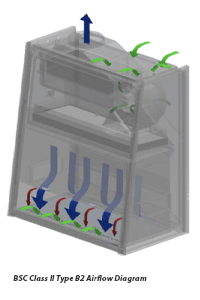
Class II Type B2
The Class II Type B2 biosafety cabinets are suitable for work with toxic chemicals employed as an adjunct to microbiological processes under all circumstances since no re-circulation occurs. In theory, Type B2 biological safety cabinets may be considered as the safest of all Class II BSCs since the total exhaust feature acts as a fail-safe in the event that the downflow and / or exhaust HEPA filtration systems cease to function normally. However, Class II Type B2 biosafety cabinets require large laboratory spaces due to their installation system and will require elaborate ducting works.
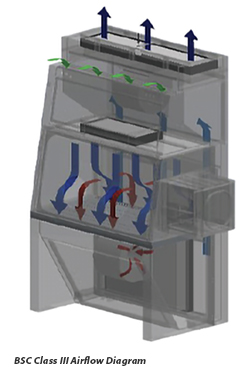
Class III Biological Safety Cabinets (BSCs) are designed for work involving microbiological agents assigned to Biosafety Levels 1, 2, 3, and 4, and are commonly specified for applications involving highly hazardous biological agents.
All work is performed through glove ports located at the front of the cabinet, ensuring complete physical separation between the operator and the work area. During normal operation, the cabinet maintains negative pressure relative to the surrounding environment. The cabinet is equipped with dual HEPA filtration on the exhaust system to provide an additional level of protection for personnel and the surrounding environment.
Enligt WHO Laboratory Biosafety Manual, 4:e upplagan, påverkas den faktiska risken i ett givet scenario inte bara av det agens som hanteras, utan också av den procedur som utförs och kompetensen hos den laboratoriepersonal som deltar i laboratorieverksamheten.
Riskgrupper är klassificeringar som beskriver den relativa fara som infektiösa agenser eller toxiner utgör i laboratoriet.
Världshälsoorganisationen (WHO) definierar riskgrupperna som:
- WHO riskgrupp 1 – ingen eller låg individuell risk och samhällsrisk
- WHO riskgrupp 2 – måttlig individuell risk, låg samhällsrisk
- WHO riskgrupp 3 – hög individuell risk, låg samhällsrisk
- WHO riskgrupp 4 – hög individuell risk och samhällsrisk
Säkerhetsbänkar omcertifieras årligen och/eller när de flyttas.
Enligt WHO Laboratory Biosafety Manual, 3:e upplagan, är de flesta säkerhetsbänkar utformade för att tillåta drift 24 h/dygn. Det har visat sig att kontinuerlig drift hjälper till att kontrollera nivåerna av damm och partiklar i laboratoriet.
Den beräknade hållbarhetstiden för HEPA- eller ULPA-filter är upp till 10 år vid korrekt förvaring.
Filter bör förvaras i originalförpackningen och bör inte utsättas för fukt, extrem värme, kyla eller snabbt växlande temperaturer. Dessa filter tål upp till 95% luftfuktighet; allt över det kan göra att filtermediet blockeras och slutar fungera.