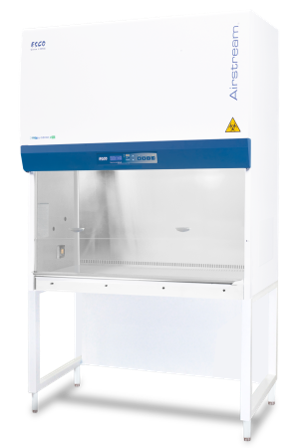
Ang Biological Safety Cabinet (BSC), na kilala rin bilang isang Biosafety Cabinet, ay pangunahing ginagamit sa paghawak ng mga pathogenic na biyolohikal na sample o para sa mga aplikasyong nangangailangan ng sterile na sona ng pagtatrabaho. Ang isang Biological Safety Cabinet ay lumilikha ng inflow at downflow ng hangin na nagbibigay ng proteksyon sa operator. Ang downflow na hangin ay dumaraan sa isang ULPA/HEPA filter at lumilikha ng isang ISO Class 3 na sona ng pagtatrabaho upang protektahan ang mga sample mula sa panganib ng cross-contamination. Ang hanging inilalabas ay dumaraan din sa isang ULPA/HEPA filter bago ilabas upang protektahan ang kapaligiran.
Ang mga Esco Biosafety Cabinet ay may malawak na hanay ng mga opsyon mula sa mga work tray, konstruksyon ng side panel hanggang sa mga aksesorya. Ang mga Esco BSC ay idinisenyo nang may mga katangiang ergonomiko at nakakatipid sa enerhiya.
Upang magarantiyahan ang pinakamainam na pagganap ng Biological Safety Cabinet, ang mga ito ay sinusubukan at inuuri ayon sa 2 pamantayan: EN 12469:2000 at NSF 49.

EN 12469
Ang EN 12469: 2000 Biotechnology - Mga pamantayan sa pagganap ng mga microbiological safety cabinet ay ang bagong pinag-isang pamantayang Europeo para sa mga Biological Safety Cabinet, na inilathala ng CEN, ang European Committee for Standardization. Inuuri ng pamantayang ito ang mga BSC sa Class I, Class II, at Class III.

NSF
Ang NSF International (dating The National Sanitation Foundation) Biological Safety Cabinetry Program ay pinasimulan noong dekada 1970 sa kahilingan ng komunidad ng regulasyon, kabilang ang Centers for Disease Control (CDC), National Institutes of Health (NIH), at ang National Cancer Institute (NCI). Higit pang inuuri ng pamantayang ito ang mga Class II Biosafety Cabinet ayon sa mga subtype batay sa sirkulasyon ng hangin: Class II Type A1, Class II Type A2, Class II Type B1, at Class II Type B2.
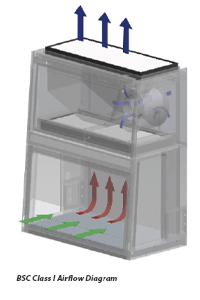
A Class I Biosafety cabinet protects the operator and the environment from exposure to biohazards. It does not prevent samples being handled in the cabinet from being exposed to contaminants that may be present in room air. Naturally, there is a possibility of cross-contamination that may affect experimental consistency. Consequently, the scope and application of Class I cabinets is limited, and it is largely considered obsolete.
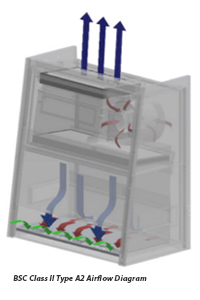
Class II Type A2
The Class II Type A2 biological safety cabinet is the most common Class II cabinet. It has a plenum from which 30% of air is exhausted, and 70% re-circulated to the work area as the downflow.
Stated from NSF/ ANSI 49:2010, both the Class II Type A1 and Type A2 must have the positively-pressurized contaminated plenum to be surrounded by negative pressure. In case there is a leakage on the positive plenum, the leaking aerosol will be pulled by the negative pressure back to the positive plenum, and it will not leak out.
In the A2 cabinet, about 70% of air from the positive plenum is recirculated as downflow, and the remaining 30% is discharged to the lab through the exhaust filter.
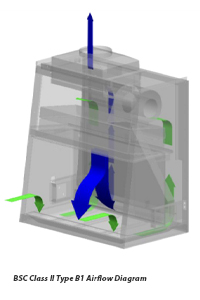
Class II Type B1
The Class II Type B1 biological safety cabinet has a common plenum from which 70% of air is exhausted, and 30% re-circulated to the work area as the downflow. This cabinet also has a dedicated exhaust feature that eliminates re-circulation when work is performed towards the back within the interior of the cabinet. Toxic chemicals employed as an adjunct to microbiological processes should only be allowed if they do not interfere with work when re-circulated in the downflow.
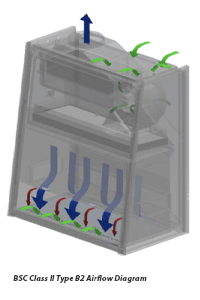
Class II Type B2
The Class II Type B2 biosafety cabinets are suitable for work with toxic chemicals employed as an adjunct to microbiological processes under all circumstances since no re-circulation occurs. In theory, Type B2 biological safety cabinets may be considered as the safest of all Class II BSCs since the total exhaust feature acts as a fail-safe in the event that the downflow and / or exhaust HEPA filtration systems cease to function normally. However, Class II Type B2 biosafety cabinets require large laboratory spaces due to their installation system and will require elaborate ducting works.
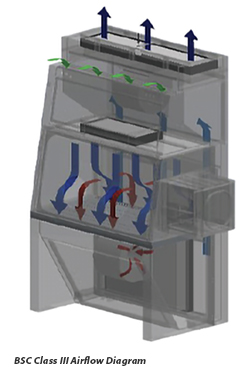
Class III Biological Safety Cabinets (BSCs) are designed for work involving microbiological agents assigned to Biosafety Levels 1, 2, 3, and 4, and are commonly specified for applications involving highly hazardous biological agents.
All work is performed through glove ports located at the front of the cabinet, ensuring complete physical separation between the operator and the work area. During normal operation, the cabinet maintains negative pressure relative to the surrounding environment. The cabinet is equipped with dual HEPA filtration on the exhaust system to provide an additional level of protection for personnel and the surrounding environment.
Ayon sa WHO Laboratory Biosafety Manual 4th Edition, ang aktwal na panganib ng isang partikular na senaryo ay naiimpluwensyahan hindi lamang ng ahenteng hinahawakan, kundi pati na rin ng pamamaraang isinasagawa at ng kakayahan ng mga tauhan sa laboratoryo na nakikibahagi sa aktibidad sa laboratoryo.
Ang mga Risk Group ay mga klasipikasyon na naglalarawan sa relatibong panganib na dulot ng mga nakakahawang ahente o lason sa laboratoryo.
Tinutukoy ng World Health Organization (WHO) ang mga risk group bilang:
- WHO Risk Group 1- wala o mababang panganib sa indibidwal at komunidad
- WHO Risk Group 2- katamtamang panganib sa indibidwal, mababang panganib sa komunidad
- WHO Risk Group 3- mataas na panganib sa indibidwal, mababang panganib sa komunidad
- WHO Risk Group 4- mataas na panganib sa indibidwal at komunidad
Ang mga Biosafety Cabinet ay muling sinosertipikahan taon-taon at/o tuwing inililipat ang mga ito.
Ayon sa WHO Laboratory biosafety manual, 3rd edition, karamihan sa mga BSC ay idinisenyo upang pahintulutan ang operasyon 24 h/araw. Napag-alaman na ang tuluy-tuloy na operasyon ay tumutulong na kontrolin ang mga antas ng alikabok at mga particulate material sa laboratoryo.
Ang tinatayang shelf life ng mga HEPA o ULPA filter ay hanggang 10 taon kapag maayos na nakaimbak.
Ang mga filter ay dapat panatilihin sa kanilang orihinal na packaging at hindi dapat maipailalim sa kahalumigmigan, labis na init, lamig o mabilis na nagbabagong mga temperatura. Ang mga filter na ito ay makakayanan ang hanggang 95% na halumigmig; ang anupamang mas mataas ay maaaring maging sanhi ng pagbara at pagpalya ng filter media.