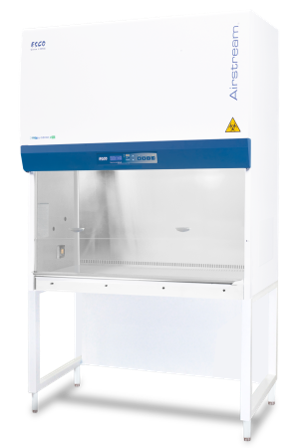
Tủ an toàn sinh học (Biological Safety Cabinet, BSC), còn được gọi là Biosafety Cabinet, chủ yếu được sử dụng để xử lý các mẫu sinh học gây bệnh hoặc cho các ứng dụng yêu cầu khu vực làm việc vô trùng. Tủ an toàn sinh học tạo ra luồng khí hút vào và dòng khí thổi xuống giúp bảo vệ người vận hành. Luồng khí thổi xuống đi qua bộ lọc ULPA/HEPA và tạo ra vùng làm việc đạt chuẩn ISO Class 3 để bảo vệ mẫu khỏi nguy cơ nhiễm chéo. Khí thải ra cũng đi qua bộ lọc ULPA/HEPA trước khi thải ra ngoài để bảo vệ môi trường.
Các tủ an toàn sinh học Esco có nhiều tùy chọn từ khay làm việc, cấu trúc tấm bên đến phụ kiện. Các tủ BSC của Esco được thiết kế với các tính năng công thái học và tiết kiệm năng lượng.
Để đảm bảo hiệu suất tối ưu của tủ an toàn sinh học, các thiết bị này được kiểm tra và phân loại theo 2 tiêu chuẩn: EN 12469:2000 và NSF 49.

EN 12469
EN 12469: 2000 Công nghệ sinh học - Tiêu chí hiệu suất cho tủ an toàn sinh học là tiêu chuẩn hài hòa mới của Châu Âu dành cho tủ an toàn sinh học, do CEN - Ủy ban Tiêu chuẩn hóa Châu Âu công bố. Tiêu chuẩn này phân loại các tủ BSC thành Cấp I, Cấp II và Cấp III.

NSF
Chương trình tủ an toàn sinh học của NSF International (trước đây là The National Sanitation Foundation) được khởi xướng vào những năm 1970 theo yêu cầu của cộng đồng cơ quan quản lý, bao gồm Trung tâm Kiểm soát và Phòng ngừa Dịch bệnh (CDC), Viện Y tế Quốc gia (NIH) và Viện Ung thư Quốc gia (NCI). Tiêu chuẩn này phân loại chi tiết hơn tủ an toàn sinh học Cấp II theo các phân loại phụ dựa trên sự lưu thông không khí: Cấp II Loại A1, Cấp II Loại A2, Cấp II Loại B1 và Cấp II Loại B2.
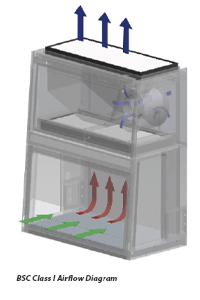
A Class I Biosafety cabinet protects the operator and the environment from exposure to biohazards. It does not prevent samples being handled in the cabinet from being exposed to contaminants that may be present in room air. Naturally, there is a possibility of cross-contamination that may affect experimental consistency. Consequently, the scope and application of Class I cabinets is limited, and it is largely considered obsolete.
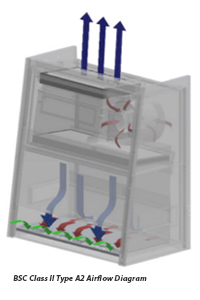
Class II Type A2
The Class II Type A2 biological safety cabinet is the most common Class II cabinet. It has a plenum from which 30% of air is exhausted, and 70% re-circulated to the work area as the downflow.
Stated from NSF/ ANSI 49:2010, both the Class II Type A1 and Type A2 must have the positively-pressurized contaminated plenum to be surrounded by negative pressure. In case there is a leakage on the positive plenum, the leaking aerosol will be pulled by the negative pressure back to the positive plenum, and it will not leak out.
In the A2 cabinet, about 70% of air from the positive plenum is recirculated as downflow, and the remaining 30% is discharged to the lab through the exhaust filter.
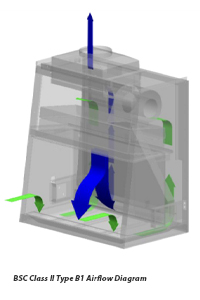
Class II Type B1
The Class II Type B1 biological safety cabinet has a common plenum from which 70% of air is exhausted, and 30% re-circulated to the work area as the downflow. This cabinet also has a dedicated exhaust feature that eliminates re-circulation when work is performed towards the back within the interior of the cabinet. Toxic chemicals employed as an adjunct to microbiological processes should only be allowed if they do not interfere with work when re-circulated in the downflow.
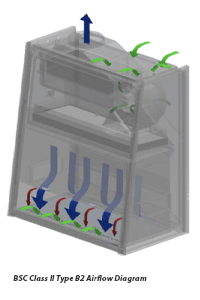
Class II Type B2
The Class II Type B2 biosafety cabinets are suitable for work with toxic chemicals employed as an adjunct to microbiological processes under all circumstances since no re-circulation occurs. In theory, Type B2 biological safety cabinets may be considered as the safest of all Class II BSCs since the total exhaust feature acts as a fail-safe in the event that the downflow and / or exhaust HEPA filtration systems cease to function normally. However, Class II Type B2 biosafety cabinets require large laboratory spaces due to their installation system and will require elaborate ducting works.
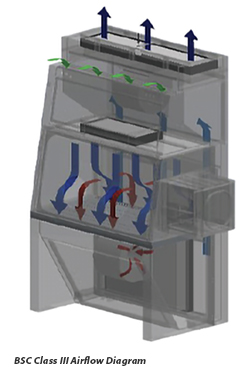
Class III Biological Safety Cabinets (BSCs) are designed for work involving microbiological agents assigned to Biosafety Levels 1, 2, 3, and 4, and are commonly specified for applications involving highly hazardous biological agents.
All work is performed through glove ports located at the front of the cabinet, ensuring complete physical separation between the operator and the work area. During normal operation, the cabinet maintains negative pressure relative to the surrounding environment. The cabinet is equipped with dual HEPA filtration on the exhaust system to provide an additional level of protection for personnel and the surrounding environment.
Theo Cẩm nang An toàn sinh học Phòng thí nghiệm của WHO Tái bản lần thứ 4, rủi ro thực tế của một tình huống cụ thể không chỉ bị ảnh hưởng bởi tác nhân đang được xử lý, mà còn bởi quy trình đang được thực hiện và năng lực của nhân viên phòng thí nghiệm tham gia vào hoạt động của phòng thí nghiệm.
Các nhóm nguy cơ là những phân loại mô tả mối nguy hiểm tương đối do các tác nhân truyền nhiễm hoặc độc tố gây ra trong phòng thí nghiệm.
Tổ chức Y tế Thế giới (WHO) định nghĩa các nhóm nguy cơ như sau:
- Nhóm nguy cơ 1 của WHO- không có hoặc có nguy cơ thấp đối với cá nhân và cộng đồng
- Nhóm nguy cơ 2 của WHO- nguy cơ đối với cá nhân ở mức độ vừa phải, nguy cơ đối với cộng đồng thấp
- Nhóm nguy cơ 3 của WHO- nguy cơ cao đối với cá nhân, nguy cơ thấp đối với cộng đồng
- Nhóm nguy cơ 4 của WHO- nguy cơ cao đối với cá nhân và cộng đồng
Các tủ an toàn sinh học được tái chứng nhận hàng năm và/hoặc bất cứ khi nào chúng được di chuyển.
Theo Cẩm nang an toàn sinh học phòng thí nghiệm của WHO, tái bản lần thứ 3, hầu hết các tủ BSC được thiết kế để cho phép vận hành 24 giờ/ngày. Người ta thấy rằng việc vận hành liên tục giúp kiểm soát mức độ bụi và các vật liệu dạng hạt trong phòng thí nghiệm.
Thời hạn sử dụng ước tính của bộ lọc HEPA hoặc ULPA lên đến 10 năm khi được bảo quản đúng cách.
Bộ lọc nên được giữ trong bao bì gốc của chúng và không nên tiếp xúc với độ ẩm, nhiệt độ quá cao, quá lạnh hoặc nhiệt độ thay đổi nhanh chóng. Các bộ lọc này có thể chịu được độ ẩm lên đến 95%; bất kỳ mức nào cao hơn đều có thể làm tắc nghẽn và hỏng vật liệu lọc.