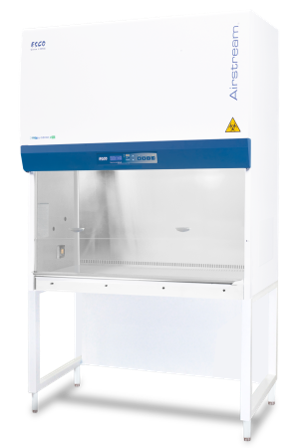
Mikrobiologista suojakaappia (BSC), jota kutsutaan myös mikrobiologiseksi suojakaapiksi, käytetään pääasiassa patogeenisten biologisten näytteiden käsittelyyn tai sovelluksiin, jotka vaativat steriiliä työskentelyaluetta. Mikrobiologinen suojakaappi luo ilman sisäänvirtauksen ja alasvirtauksen, mikä suojaa käyttäjää. Alasvirtausilma kulkee ULPA/HEPA-suodattimen läpi ja luo ISO-luokan 3 työskentelyalueen, joka suojaa näytteitä ristikontaminaation riskiltä. Myös poistoilma kulkee ULPA/HEPA-suodattimen läpi ennen vapautumista ympäristön suojelemiseksi.
Escon mikrobiologisissa suojakaapeissa on laaja valikoima vaihtoehtoja pohjalevyistä ja sivupaneelien rakenteesta lisävarusteisiin. Escon mikrobiologiset suojakaapit on suunniteltu ergonomisilla ja energiaa säästävillä ominaisuuksilla.
Mikrobiologisen suojakaapin optimaalisen suorituskyvyn takaamiseksi ne on testattu ja luokiteltu 2 standardin mukaan: EN 12469:2000 ja NSF 49.

EN 12469
EN 12469: 2000 Biotekniikka - Mikrobiologisten suojakaappien suorituskykyvaatimukset on uusi yhdenmukaistettu eurooppalainen standardi mikrobiologisille suojakaapeille, jonka on julkaissut eurooppalainen standardointikomitea CEN. Tämä standardi luokittelee mikrobiologiset suojakaapit luokkaan I, luokkaan II ja luokkaan III.

NSF
NSF Internationalin (aiemmin National Sanitation Foundation) mikrobiologisten suojakaappien ohjelma aloitettiin 1970-luvulla sääntelyviranomaisten pyynnöstä, mukaan lukien Centers for Disease Control (CDC), National Institutes of Health (NIH) ja National Cancer Institute (NCI). Tämä standardi luokittelee luokan II mikrobiologiset suojakaapit edelleen alatyypeiksi ilmankierron perusteella: Luokka II Tyyppi A1, Luokka II Tyyppi A2, Luokka II Tyyppi B1 ja Luokka II Tyyppi B2.
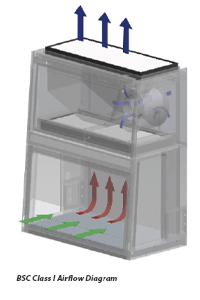
A Class I Biosafety cabinet protects the operator and the environment from exposure to biohazards. It does not prevent samples being handled in the cabinet from being exposed to contaminants that may be present in room air. Naturally, there is a possibility of cross-contamination that may affect experimental consistency. Consequently, the scope and application of Class I cabinets is limited, and it is largely considered obsolete.
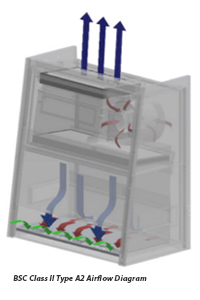
Class II Type A2
The Class II Type A2 biological safety cabinet is the most common Class II cabinet. It has a plenum from which 30% of air is exhausted, and 70% re-circulated to the work area as the downflow.
Stated from NSF/ ANSI 49:2010, both the Class II Type A1 and Type A2 must have the positively-pressurized contaminated plenum to be surrounded by negative pressure. In case there is a leakage on the positive plenum, the leaking aerosol will be pulled by the negative pressure back to the positive plenum, and it will not leak out.
In the A2 cabinet, about 70% of air from the positive plenum is recirculated as downflow, and the remaining 30% is discharged to the lab through the exhaust filter.
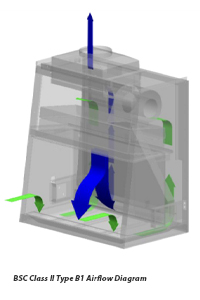
Class II Type B1
The Class II Type B1 biological safety cabinet has a common plenum from which 70% of air is exhausted, and 30% re-circulated to the work area as the downflow. This cabinet also has a dedicated exhaust feature that eliminates re-circulation when work is performed towards the back within the interior of the cabinet. Toxic chemicals employed as an adjunct to microbiological processes should only be allowed if they do not interfere with work when re-circulated in the downflow.
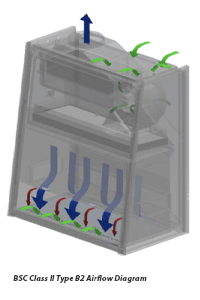
Class II Type B2
The Class II Type B2 biosafety cabinets are suitable for work with toxic chemicals employed as an adjunct to microbiological processes under all circumstances since no re-circulation occurs. In theory, Type B2 biological safety cabinets may be considered as the safest of all Class II BSCs since the total exhaust feature acts as a fail-safe in the event that the downflow and / or exhaust HEPA filtration systems cease to function normally. However, Class II Type B2 biosafety cabinets require large laboratory spaces due to their installation system and will require elaborate ducting works.
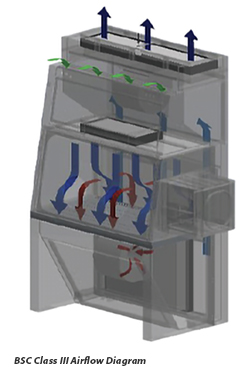
Class III Biological Safety Cabinets (BSCs) are designed for work involving microbiological agents assigned to Biosafety Levels 1, 2, 3, and 4, and are commonly specified for applications involving highly hazardous biological agents.
All work is performed through glove ports located at the front of the cabinet, ensuring complete physical separation between the operator and the work area. During normal operation, the cabinet maintains negative pressure relative to the surrounding environment. The cabinet is equipped with dual HEPA filtration on the exhaust system to provide an additional level of protection for personnel and the surrounding environment.
WHO:n Laboratory Biosafety Manual -oppaan 4. painoksen mukaan tietyn tilanteen todelliseen riskiin vaikuttaa käsiteltävän tekijän lisäksi myös suoritettava toimenpide ja laboratoriotoimintaan osallistuvan laboratoriohenkilöstön pätevyys.
Riskiryhmät ovat luokituksia, jotka kuvaavat tartuntavaarallisten tekijöiden tai toksiinien laboratoriossa aiheuttamaa suhteellista vaaraa.
Maailman terveysjärjestö (WHO) määrittelee riskiryhmät seuraavasti:
- WHO-riskiryhmä 1 – ei henkilö- tai yhteisöriskiä tai se on vähäinen
- WHO-riskiryhmä 2 – kohtalainen henkilöriski, vähäinen yhteisöriski
- WHO-riskiryhmä 3 – korkea henkilöriski, vähäinen yhteisöriski
- WHO-riskiryhmä 4 – korkea henkilö- ja yhteisöriski
Mikrobiologiset suojakaapit uudelleensertifioidaan vuosittain ja/tai aina, kun niitä siirretään.
WHO:n Laboratory biosafety manual -oppaan 3. painoksen mukaan useimmat mikrobiologiset suojakaapit on suunniteltu sallimaan käyttö 24 h/vrk. Jatkuvan käytön havaittiin auttavan hallitsemaan pölyn ja hiukkasmateriaalien tasoa laboratoriossa.
HEPA- tai ULPA-suodattimien arvioitu säilyvyysaika on asianmukaisesti säilytettynä jopa 10 vuotta.
Suodattimet tulee säilyttää alkuperäispakkauksessaan, eikä niitä saa altistaa kosteudelle, liialliselle kuumuudelle, kylmyydelle tai nopeasti muuttuville lämpötiloille. Nämä suodattimet kestävät jopa 95% kosteutta; sitä korkeampi kosteus voi aiheuttaa suodatinmateriaalin tukkeutumisen ja vikaantumisen.