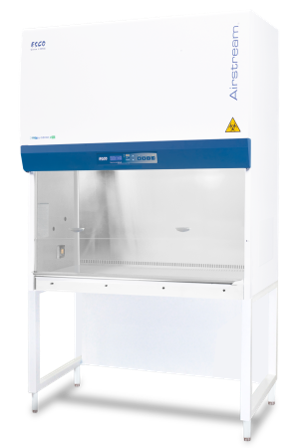
Et mikrobiologisk sikkerhetskabinett (BSC), også kjent som et biosikkerhetskabinett, brukes hovedsakelig til håndtering av patogene biologiske prøver eller til bruksområder som krever en steril arbeidssone. Et mikrobiologisk sikkerhetskabinett skaper innstrøm og nedstrøm av luft som gir operatørbeskyttelse. Nedstrømsluften passerer gjennom et ULPA/HEPA-filter og skaper en ISO klasse 3-arbeidssone for å beskytte prøver mot risiko for krysskontaminering. Den utblåste luften passerer også gjennom et ULPA/HEPA-filter før utslipp for å beskytte miljøet.
Escos mikrobiologiske sikkerhetskabinetter har et bredt spekter av alternativer fra arbeidsbrett og sidepanelkonstruksjon til tilbehør. Esco BSC-er er utformet med ergonomiske og energisparende funksjoner.
For å garantere det mikrobiologiske sikkerhetskabinettets optimale ytelse blir disse testet og klassifisert etter 2 standarder: EN 12469:2000 og NSF 49.

EN 12469
EN 12469: 2000 Bioteknologi – Ytelseskriterier for mikrobiologiske sikkerhetskabinetter er den nye harmoniserte europeiske standarden for mikrobiologiske sikkerhetskabinetter, utgitt av CEN, den europeiske standardiseringsorganisasjonen. Denne standarden klassifiserer BSC-er i klasse I, klasse II og klasse III.

NSF
NSF International (tidligere The National Sanitation Foundation) sitt program for mikrobiologiske sikkerhetskabinetter ble igangsatt på 1970-tallet etter anmodning fra tilsynsmyndighetene, inkludert Centers for Disease Control (CDC), National Institutes of Health (NIH) og National Cancer Institute (NCI). Denne standarden klassifiserer klasse II mikrobiologiske sikkerhetskabinetter ytterligere i undertyper basert på luftsirkulasjon: klasse II type A1, klasse II type A2, klasse II type B1 og klasse II type B2.
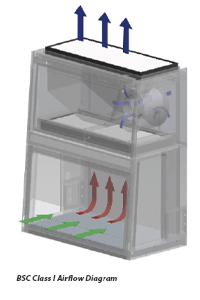
A Class I Biosafety cabinet protects the operator and the environment from exposure to biohazards. It does not prevent samples being handled in the cabinet from being exposed to contaminants that may be present in room air. Naturally, there is a possibility of cross-contamination that may affect experimental consistency. Consequently, the scope and application of Class I cabinets is limited, and it is largely considered obsolete.
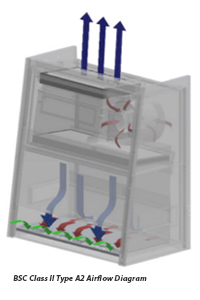
Class II Type A2
The Class II Type A2 biological safety cabinet is the most common Class II cabinet. It has a plenum from which 30% of air is exhausted, and 70% re-circulated to the work area as the downflow.
Stated from NSF/ ANSI 49:2010, both the Class II Type A1 and Type A2 must have the positively-pressurized contaminated plenum to be surrounded by negative pressure. In case there is a leakage on the positive plenum, the leaking aerosol will be pulled by the negative pressure back to the positive plenum, and it will not leak out.
In the A2 cabinet, about 70% of air from the positive plenum is recirculated as downflow, and the remaining 30% is discharged to the lab through the exhaust filter.
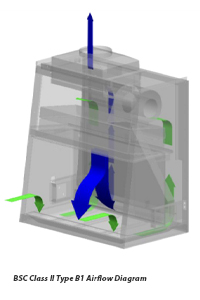
Class II Type B1
The Class II Type B1 biological safety cabinet has a common plenum from which 70% of air is exhausted, and 30% re-circulated to the work area as the downflow. This cabinet also has a dedicated exhaust feature that eliminates re-circulation when work is performed towards the back within the interior of the cabinet. Toxic chemicals employed as an adjunct to microbiological processes should only be allowed if they do not interfere with work when re-circulated in the downflow.
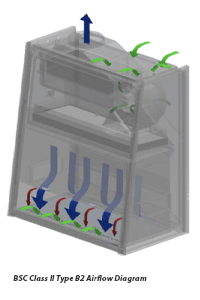
Class II Type B2
The Class II Type B2 biosafety cabinets are suitable for work with toxic chemicals employed as an adjunct to microbiological processes under all circumstances since no re-circulation occurs. In theory, Type B2 biological safety cabinets may be considered as the safest of all Class II BSCs since the total exhaust feature acts as a fail-safe in the event that the downflow and / or exhaust HEPA filtration systems cease to function normally. However, Class II Type B2 biosafety cabinets require large laboratory spaces due to their installation system and will require elaborate ducting works.
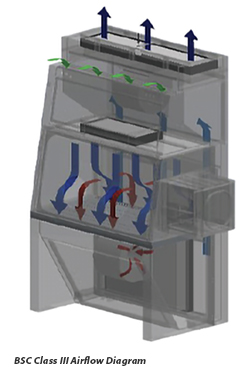
Class III Biological Safety Cabinets (BSCs) are designed for work involving microbiological agents assigned to Biosafety Levels 1, 2, 3, and 4, and are commonly specified for applications involving highly hazardous biological agents.
All work is performed through glove ports located at the front of the cabinet, ensuring complete physical separation between the operator and the work area. During normal operation, the cabinet maintains negative pressure relative to the surrounding environment. The cabinet is equipped with dual HEPA filtration on the exhaust system to provide an additional level of protection for personnel and the surrounding environment.
I henhold til WHO Laboratory Biosafety Manual 4. utgave påvirkes den faktiske risikoen i et gitt scenario ikke bare av agensen som håndteres, men også av prosedyren som utføres og kompetansen til laboratoriepersonellet som deltar i laboratorieaktiviteten.
Risikogrupper er klassifiseringer som beskriver den relative faren som smittestoffer eller toksiner i laboratoriet utgjør.
Verdens helseorganisasjon (WHO) definerer risikogruppene som:
- WHO risikogruppe 1 – ingen eller lav individuell og samfunnsmessig risiko
- WHO risikogruppe 2 – moderat individuell risiko, lav samfunnsmessig risiko
- WHO risikogruppe 3 – høy individuell risiko, lav samfunnsmessig risiko
- WHO risikogruppe 4 – høy individuell og samfunnsmessig risiko
Mikrobiologiske sikkerhetskabinetter resertifiseres årlig og/eller når de flyttes.
Ifølge WHO Laboratory biosafety manual, 3. utgave, er de fleste BSC-er utformet for å tillate drift 24 timer i døgnet. Det ble funnet at kontinuerlig drift bidrar til å kontrollere nivåene av støv og partikkelmaterialer i laboratoriet.
Den anslåtte holdbarheten til HEPA- eller ULPA-filtre er opptil 10 år ved riktig oppbevaring.
Filtre bør oppbevares i originalemballasjen og må ikke utsettes for fuktighet, sterk varme, kulde eller raske temperaturendringer. Disse filtrene tåler opptil 95% fuktighet; alt som er høyere kan føre til at filtermediet blokkeres og svikter.