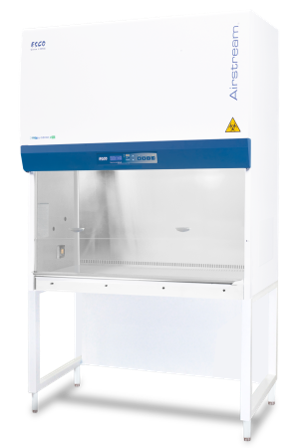
Een microbiologisch veiligheidskabinet (BSC), ook wel biosafety cabinet genoemd, wordt hoofdzakelijk gebruikt voor het hanteren van pathogene biologische monsters of voor toepassingen die een steriele werkzone vereisen. Een microbiologisch veiligheidskabinet creëert een inwaartse en neerwaartse luchtstroom die bescherming biedt aan de gebruiker. De neerwaartse luchtstroom passeert een ULPA/HEPA-filter en creëert een ISO Class 3-werkzone om monsters te beschermen tegen het risico van kruisbesmetting. De afgevoerde lucht passeert vóór uitstoot eveneens een ULPA/HEPA-filter ter bescherming van het milieu.
Esco microbiologische veiligheidskabinetten bieden een breed scala aan opties, variërend van werkbladen en zijpaneelconstructies tot accessoires. Esco BSC's zijn ontworpen met ergonomische en energiebesparende eigenschappen.
Om de optimale prestaties van het microbiologisch veiligheidskabinet te garanderen, worden deze getest en geclassificeerd volgens 2 normen: EN 12469:2000 en NSF 49.

EN 12469
EN 12469: 2000 Biotechnologie - Prestatie-eisen voor microbiologische veiligheidskabinetten is de nieuwe geharmoniseerde Europese norm voor microbiologische veiligheidskabinetten, gepubliceerd door CEN, het Europees Comité voor Normalisatie. Deze norm deelt BSC's in in Klasse I, Klasse II en Klasse III.

NSF
Het Biological Safety Cabinetry Program van NSF International (voorheen The National Sanitation Foundation) werd in de jaren 1970 gestart op verzoek van regelgevende instanties, waaronder de Centers for Disease Control (CDC), National Institutes of Health (NIH) en het National Cancer Institute (NCI). Deze norm verdeelt microbiologische veiligheidskabinetten van Klasse II verder in subtypen op basis van luchtcirculatie: Klasse II Type A1, Klasse II Type A2, Klasse II Type B1 en Klasse II Type B2.
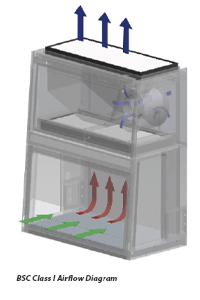
A Class I Biosafety cabinet protects the operator and the environment from exposure to biohazards. It does not prevent samples being handled in the cabinet from being exposed to contaminants that may be present in room air. Naturally, there is a possibility of cross-contamination that may affect experimental consistency. Consequently, the scope and application of Class I cabinets is limited, and it is largely considered obsolete.
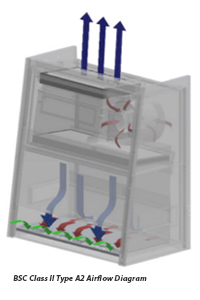
Class II Type A2
The Class II Type A2 biological safety cabinet is the most common Class II cabinet. It has a plenum from which 30% of air is exhausted, and 70% re-circulated to the work area as the downflow.
Stated from NSF/ ANSI 49:2010, both the Class II Type A1 and Type A2 must have the positively-pressurized contaminated plenum to be surrounded by negative pressure. In case there is a leakage on the positive plenum, the leaking aerosol will be pulled by the negative pressure back to the positive plenum, and it will not leak out.
In the A2 cabinet, about 70% of air from the positive plenum is recirculated as downflow, and the remaining 30% is discharged to the lab through the exhaust filter.
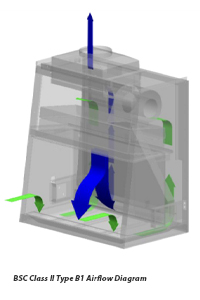
Class II Type B1
The Class II Type B1 biological safety cabinet has a common plenum from which 70% of air is exhausted, and 30% re-circulated to the work area as the downflow. This cabinet also has a dedicated exhaust feature that eliminates re-circulation when work is performed towards the back within the interior of the cabinet. Toxic chemicals employed as an adjunct to microbiological processes should only be allowed if they do not interfere with work when re-circulated in the downflow.
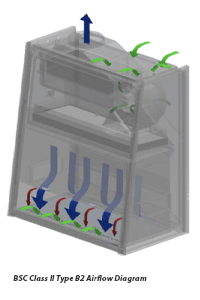
Class II Type B2
The Class II Type B2 biosafety cabinets are suitable for work with toxic chemicals employed as an adjunct to microbiological processes under all circumstances since no re-circulation occurs. In theory, Type B2 biological safety cabinets may be considered as the safest of all Class II BSCs since the total exhaust feature acts as a fail-safe in the event that the downflow and / or exhaust HEPA filtration systems cease to function normally. However, Class II Type B2 biosafety cabinets require large laboratory spaces due to their installation system and will require elaborate ducting works.
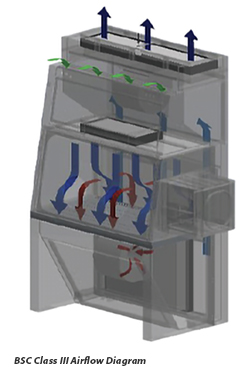
Class III Biological Safety Cabinets (BSCs) are designed for work involving microbiological agents assigned to Biosafety Levels 1, 2, 3, and 4, and are commonly specified for applications involving highly hazardous biological agents.
All work is performed through glove ports located at the front of the cabinet, ensuring complete physical separation between the operator and the work area. During normal operation, the cabinet maintains negative pressure relative to the surrounding environment. The cabinet is equipped with dual HEPA filtration on the exhaust system to provide an additional level of protection for personnel and the surrounding environment.
Volgens de WHO Laboratory Biosafety Manual 4th Edition wordt het werkelijke risico van een bepaald scenario niet alleen beïnvloed door het agens dat wordt gehanteerd, maar ook door de procedure die wordt uitgevoerd en de bekwaamheid van het laboratoriumpersoneel dat bij de laboratoriumactiviteit betrokken is.
Risicogroepen zijn classificaties die het relatieve gevaar beschrijven dat infectieuze agentia of toxinen in het laboratorium vormen.
De Wereldgezondheidsorganisatie (WHO) definieert de risicogroepen als:
- WHO-risicogroep 1- geen of laag individueel en maatschappelijk risico
- WHO-risicogroep 2- matig individueel risico, laag maatschappelijk risico
- WHO-risicogroep 3- hoog individueel risico, laag maatschappelijk risico
- WHO-risicogroep 4- hoog individueel en maatschappelijk risico
Microbiologische veiligheidskabinetten worden jaarlijks en/of telkens wanneer ze worden verplaatst opnieuw gecertificeerd.
Volgens de WHO Laboratory biosafety manual, 3rd edition, zijn de meeste BSC's ontworpen om 24 uur per dag in bedrijf te zijn. Er is gebleken dat een continue werking helpt om de concentraties stof en deeltjes in het laboratorium onder controle te houden.
De geschatte houdbaarheid van HEPA- of ULPA-filters is maximaal 10 jaar mits correct opgeslagen.
Filters moeten in hun originele verpakking worden bewaard en mogen niet worden blootgesteld aan vocht, extreme hitte, koude of snel wisselende temperaturen. Deze filters verdragen een luchtvochtigheid tot 95%; hogere waarden kunnen ertoe leiden dat het filtermedium verstopt raakt en defect raakt.