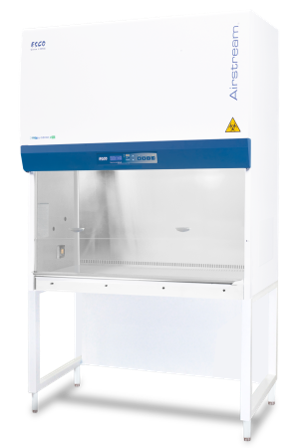
Una cappa di sicurezza biologica (BSC), nota anche come cappa di biosicurezza, viene utilizzata principalmente per la manipolazione di campioni biologici patogeni o per applicazioni che richiedono una zona di lavoro sterile. Una cappa di sicurezza biologica crea un flusso d'aria entrante e discendente che fornisce protezione all'operatore. L'aria del flusso discendente passa attraverso un filtro ULPA/HEPA e crea una zona di lavoro di classe ISO 3 per proteggere i campioni dal rischio di contaminazione incrociata. Anche l'aria di scarico passa attraverso un filtro ULPA/HEPA prima del rilascio per proteggere l'ambiente.
Le cappe di sicurezza biologica Esco dispongono di un'ampia gamma di opzioni, dai piani di lavoro alla struttura dei pannelli laterali, fino agli accessori. Le BSC Esco sono progettate con caratteristiche ergonomiche e di risparmio energetico.
Per garantire le prestazioni ottimali della cappa di sicurezza biologica, queste vengono testate e classificate secondo 2 standard: EN 12469:2000 e NSF 49.

EN 12469
EN 12469: 2000 Biotecnologie - Criteri di prestazione per le cappe di sicurezza biologica è la nuova norma europea armonizzata per le cappe di sicurezza biologica, pubblicata dal CEN, il Comitato europeo di normazione. Questo standard classifica le BSC in Classe I, Classe II e Classe III.

NSF
Il Biological Safety Cabinetry Program di NSF International (precedentemente The National Sanitation Foundation) è stato avviato negli anni 1970 su richiesta della comunità normativa, compresi i Centers for Disease Control (CDC), i National Institutes of Health (NIH) e il National Cancer Institute (NCI). Questo standard classifica ulteriormente le cappe di sicurezza biologica di Classe II in sottotipi basati sulla circolazione dell'aria: Classe II Tipo A1, Classe II Tipo A2, Classe II Tipo B1 e Classe II Tipo B2.
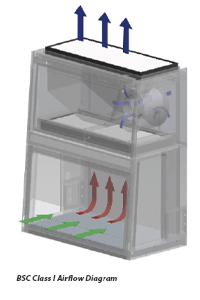
A Class I Biosafety cabinet protects the operator and the environment from exposure to biohazards. It does not prevent samples being handled in the cabinet from being exposed to contaminants that may be present in room air. Naturally, there is a possibility of cross-contamination that may affect experimental consistency. Consequently, the scope and application of Class I cabinets is limited, and it is largely considered obsolete.
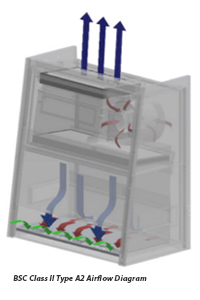
Class II Type A2
The Class II Type A2 biological safety cabinet is the most common Class II cabinet. It has a plenum from which 30% of air is exhausted, and 70% re-circulated to the work area as the downflow.
Stated from NSF/ ANSI 49:2010, both the Class II Type A1 and Type A2 must have the positively-pressurized contaminated plenum to be surrounded by negative pressure. In case there is a leakage on the positive plenum, the leaking aerosol will be pulled by the negative pressure back to the positive plenum, and it will not leak out.
In the A2 cabinet, about 70% of air from the positive plenum is recirculated as downflow, and the remaining 30% is discharged to the lab through the exhaust filter.
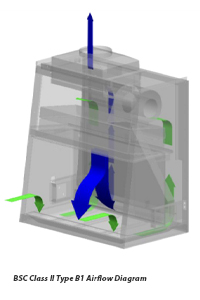
Class II Type B1
The Class II Type B1 biological safety cabinet has a common plenum from which 70% of air is exhausted, and 30% re-circulated to the work area as the downflow. This cabinet also has a dedicated exhaust feature that eliminates re-circulation when work is performed towards the back within the interior of the cabinet. Toxic chemicals employed as an adjunct to microbiological processes should only be allowed if they do not interfere with work when re-circulated in the downflow.
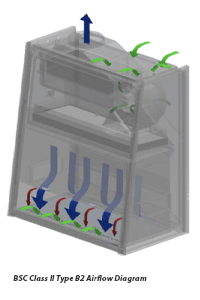
Class II Type B2
The Class II Type B2 biosafety cabinets are suitable for work with toxic chemicals employed as an adjunct to microbiological processes under all circumstances since no re-circulation occurs. In theory, Type B2 biological safety cabinets may be considered as the safest of all Class II BSCs since the total exhaust feature acts as a fail-safe in the event that the downflow and / or exhaust HEPA filtration systems cease to function normally. However, Class II Type B2 biosafety cabinets require large laboratory spaces due to their installation system and will require elaborate ducting works.
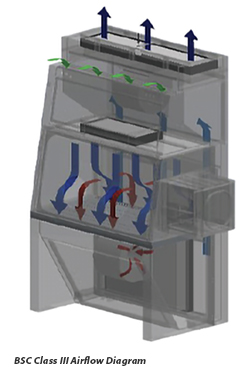
Class III Biological Safety Cabinets (BSCs) are designed for work involving microbiological agents assigned to Biosafety Levels 1, 2, 3, and 4, and are commonly specified for applications involving highly hazardous biological agents.
All work is performed through glove ports located at the front of the cabinet, ensuring complete physical separation between the operator and the work area. During normal operation, the cabinet maintains negative pressure relative to the surrounding environment. The cabinet is equipped with dual HEPA filtration on the exhaust system to provide an additional level of protection for personnel and the surrounding environment.
Secondo il Manuale di biosicurezza in laboratorio dell'OMS, 4ª edizione, il rischio effettivo di un determinato scenario è influenzato non solo dall'agente manipolato, ma anche dalla procedura eseguita e dalla competenza del personale di laboratorio impegnato nell'attività di laboratorio.
I gruppi di rischio sono classificazioni che descrivono il pericolo relativo rappresentato da agenti infettivi o tossine nel laboratorio.
L'Organizzazione mondiale della sanità (OMS) definisce i gruppi di rischio come:
- Gruppo di rischio OMS 1- rischio individuale e comunitario nullo o basso
- Gruppo di rischio OMS 2- rischio individuale moderato, basso rischio comunitario
- Gruppo di rischio OMS 3- rischio individuale elevato, basso rischio comunitario
- Gruppo di rischio OMS 4- rischio individuale e comunitario elevato
Le cappe di sicurezza biologica vengono ricertificate su base annuale e/o ogni volta che vengono spostate.
Secondo il Manuale di biosicurezza in laboratorio dell'OMS, 3ª edizione, la maggior parte delle BSC è progettata per consentire il funzionamento 24 ore al giorno. È stato riscontrato che il funzionamento continuo aiuta a controllare i livelli di polvere e particolato nel laboratorio.
La durata di conservazione stimata dei filtri HEPA o ULPA è fino a 10 anni se conservati correttamente.
I filtri devono essere conservati nella loro confezione originale e non devono essere esposti a umidità, calore eccessivo, freddo o rapidi sbalzi di temperatura. Questi filtri possono tollerare fino al 95% di umidità; valori superiori possono causare il blocco e il guasto del setto filtrante.