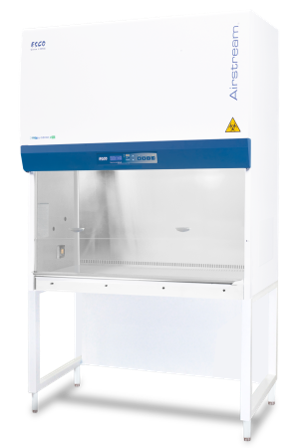
バイオハザード対策用キャビネット(BSC)は、バイオセーフティキャビネットとも呼ばれ、主に病原性生体試料の取り扱い、または無菌作業区域を必要とする用途に使用されます。バイオハザード対策用キャビネットは空気の吸込気流と下降気流を生成し、作業者を保護します。下降気流はULPA/HEPAフィルターを通過してISOクラス3の作業区域を形成し、交差汚染のリスクから試料を保護します。排気も放出前にULPA/HEPAフィルターを通過して環境を保護します。
Escoのバイオハザード対策用キャビネットには、作業トレイ、サイドパネル構造からアクセサリーに至るまで、幅広い選択肢があります。EscoのBSCは人間工学的かつ省エネ設計が施されています。
バイオハザード対策用キャビネットの最適な性能を保証するため、これらは2つの規格(EN 12469:2000およびNSF 49)によって試験および分類されています。

EN 12469
EN 12469: 2000 Biotechnology - Performance criteria for microbiological safety cabinetsは、欧州標準化委員会(CEN)によって発行された、バイオハザード対策用キャビネットに関する新しい調和欧州規格です。この規格はBSCをクラスI、クラスII、クラスIIIに分類しています。

NSF
NSF International(旧National Sanitation Foundation)のバイオハザード対策用キャビネットプログラムは、疾病対策予防センター(CDC)、国立衛生研究所(NIH)、国立がん研究所(NCI)を含む規制コミュニティの要請を受けて1970年代に開始されました。この規格はさらに、クラスIIバイオハザード対策用キャビネットを空気循環に基づくサブタイプ(クラスIIタイプA1、クラスIIタイプA2、クラスIIタイプB1、クラスIIタイプB2)に分類しています。
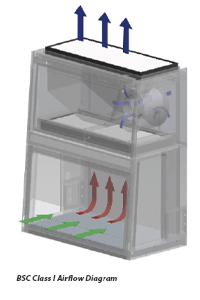
A Class I Biosafety cabinet protects the operator and the environment from exposure to biohazards. It does not prevent samples being handled in the cabinet from being exposed to contaminants that may be present in room air. Naturally, there is a possibility of cross-contamination that may affect experimental consistency. Consequently, the scope and application of Class I cabinets is limited, and it is largely considered obsolete.
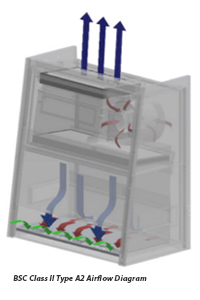
Class II Type A2
The Class II Type A2 biological safety cabinet is the most common Class II cabinet. It has a plenum from which 30% of air is exhausted, and 70% re-circulated to the work area as the downflow.
Stated from NSF/ ANSI 49:2010, both the Class II Type A1 and Type A2 must have the positively-pressurized contaminated plenum to be surrounded by negative pressure. In case there is a leakage on the positive plenum, the leaking aerosol will be pulled by the negative pressure back to the positive plenum, and it will not leak out.
In the A2 cabinet, about 70% of air from the positive plenum is recirculated as downflow, and the remaining 30% is discharged to the lab through the exhaust filter.
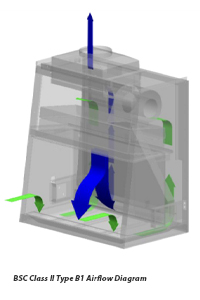
Class II Type B1
The Class II Type B1 biological safety cabinet has a common plenum from which 70% of air is exhausted, and 30% re-circulated to the work area as the downflow. This cabinet also has a dedicated exhaust feature that eliminates re-circulation when work is performed towards the back within the interior of the cabinet. Toxic chemicals employed as an adjunct to microbiological processes should only be allowed if they do not interfere with work when re-circulated in the downflow.
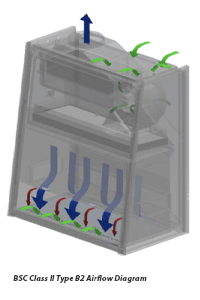
Class II Type B2
The Class II Type B2 biosafety cabinets are suitable for work with toxic chemicals employed as an adjunct to microbiological processes under all circumstances since no re-circulation occurs. In theory, Type B2 biological safety cabinets may be considered as the safest of all Class II BSCs since the total exhaust feature acts as a fail-safe in the event that the downflow and / or exhaust HEPA filtration systems cease to function normally. However, Class II Type B2 biosafety cabinets require large laboratory spaces due to their installation system and will require elaborate ducting works.
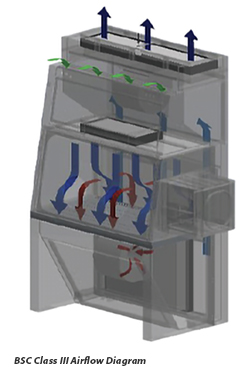
Class III Biological Safety Cabinets (BSCs) are designed for work involving microbiological agents assigned to Biosafety Levels 1, 2, 3, and 4, and are commonly specified for applications involving highly hazardous biological agents.
All work is performed through glove ports located at the front of the cabinet, ensuring complete physical separation between the operator and the work area. During normal operation, the cabinet maintains negative pressure relative to the surrounding environment. The cabinet is equipped with dual HEPA filtration on the exhaust system to provide an additional level of protection for personnel and the surrounding environment.
WHOの「実験室バイオセーフティ指針 第4版」によると、特定のシナリオにおける実際のリスクは、取り扱う病原体だけでなく、実施される手順や実験室での業務に従事する職員の能力にも影響を受けます。
リスクグループとは、実験室内の感染性病原体または毒素によってもたらされる相対的な危険性を説明する分類です。
世界保健機関(WHO)はリスクグループを次のように定義しています:
- WHOリスクグループ1—個人および社会に対する危険性はなし、または低度
- WHOリスクグループ2—中程度の個人リスク、低い社会リスク
- WHOリスクグループ3—高い個人リスク、低い社会リスク
- WHOリスクグループ4—高い個人および社会リスク
バイオハザード対策用キャビネットは、年に一回、および/または移動した場合にはその都度再認証を受けます。
WHOの「実験室バイオセーフティ指針 第3版」によると、ほとんどのBSCは一日24時間の連続運転を可能にするよう設計されています。連続稼働は、実験室内の粉塵や微粒子物質のレベルを制御するのに役立つことが確認されています。
適切に保管された場合、HEPAまたはULPAフィルターの推定保管寿命は最長10年です。
フィルターは元の梱包状態のまま保管し、湿気、過度の熱、寒さ、または急激な温度変化にさらさないようにしてください。これらのフィルターは最大95%の湿度に耐えることができますが、それを超えるとフィルターろ材が目詰まりを起こし、機能不全に陥る可能性があります。