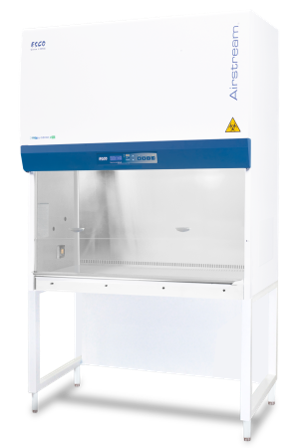
Kabinet za biološku bezbednost (BSC) uglavnom se koristi za rukovanje patogenim biološkim uzorcima ili za primene koje zahtevaju sterilnu radnu zonu. Kabinet za biološku bezbednost stvara ulazni i nadole usmeren protok vazduha koji obezbeđuje zaštitu operatera. Nadole usmeren vazduh prolazi kroz ULPA/HEPA filter i stvara radnu zonu ISO klase 3 koja štiti uzorke od rizika unakrsne kontaminacije. Odvedeni vazduh takođe prolazi kroz ULPA/HEPA filter pre ispuštanja, radi zaštite životne sredine.
Kabineti za biološku bezbednost kompanije Esco nude širok izbor opcija, od radnih tacni i konstrukcije bočnih panela do dodatne opreme. Esco BSC kabineti su projektovani sa ergonomskim karakteristikama i karakteristikama za uštedu energije.
Da bi se zagarantovale optimalne performanse kabineta za biološku bezbednost, oni se ispituju i klasifikuju prema 2 standarda: EN 12469:2000 i NSF 49.

EN 12469
EN 12469: 2000 Biotehnologija – Kriterijumi performansi za kabinete za mikrobiološku bezbednost je novi harmonizovani evropski standard za kabinete za mikrobiološku bezbednost, koji je objavio CEN, Evropski komitet za standardizaciju. Ovaj standard klasifikuje BSC kabinete u klasu I, klasu II i klasu III.

NSF
Program NSF International (ranije The National Sanitation Foundation) za kabinete za biološku bezbednost pokrenut je tokom 1970-ih na zahtev regulatornih tela, uključujući Centers for Disease Control (CDC), National Institutes of Health (NIH) i National Cancer Institute (NCI). Ovaj standard dodatno klasifikuje kabinete za biološku bezbednost klase II u podtipove prema cirkulaciji vazduha: klasa II tip A1, klasa II tip A2, klasa II tip B1 i klasa II tip B2.
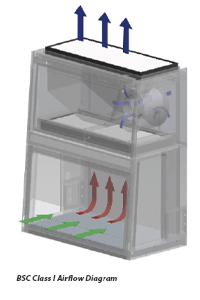
A Class I Biosafety cabinet protects the operator and the environment from exposure to biohazards. It does not prevent samples being handled in the cabinet from being exposed to contaminants that may be present in room air. Naturally, there is a possibility of cross-contamination that may affect experimental consistency. Consequently, the scope and application of Class I cabinets is limited, and it is largely considered obsolete.
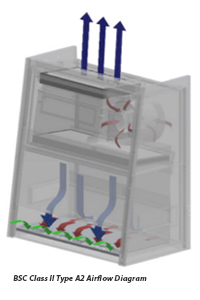
Class II Type A2
The Class II Type A2 biological safety cabinet is the most common Class II cabinet. It has a plenum from which 30% of air is exhausted, and 70% re-circulated to the work area as the downflow.
Stated from NSF/ ANSI 49:2010, both the Class II Type A1 and Type A2 must have the positively-pressurized contaminated plenum to be surrounded by negative pressure. In case there is a leakage on the positive plenum, the leaking aerosol will be pulled by the negative pressure back to the positive plenum, and it will not leak out.
In the A2 cabinet, about 70% of air from the positive plenum is recirculated as downflow, and the remaining 30% is discharged to the lab through the exhaust filter.
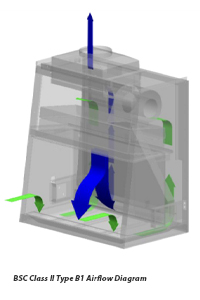
Class II Type B1
The Class II Type B1 biological safety cabinet has a common plenum from which 70% of air is exhausted, and 30% re-circulated to the work area as the downflow. This cabinet also has a dedicated exhaust feature that eliminates re-circulation when work is performed towards the back within the interior of the cabinet. Toxic chemicals employed as an adjunct to microbiological processes should only be allowed if they do not interfere with work when re-circulated in the downflow.
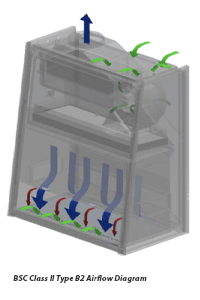
Class II Type B2
The Class II Type B2 biosafety cabinets are suitable for work with toxic chemicals employed as an adjunct to microbiological processes under all circumstances since no re-circulation occurs. In theory, Type B2 biological safety cabinets may be considered as the safest of all Class II BSCs since the total exhaust feature acts as a fail-safe in the event that the downflow and / or exhaust HEPA filtration systems cease to function normally. However, Class II Type B2 biosafety cabinets require large laboratory spaces due to their installation system and will require elaborate ducting works.
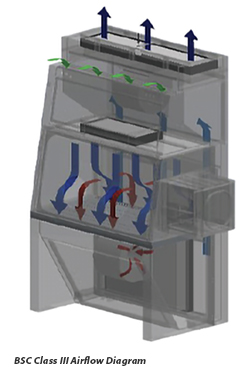
Class III Biological Safety Cabinets (BSCs) are designed for work involving microbiological agents assigned to Biosafety Levels 1, 2, 3, and 4, and are commonly specified for applications involving highly hazardous biological agents.
All work is performed through glove ports located at the front of the cabinet, ensuring complete physical separation between the operator and the work area. During normal operation, the cabinet maintains negative pressure relative to the surrounding environment. The cabinet is equipped with dual HEPA filtration on the exhaust system to provide an additional level of protection for personnel and the surrounding environment.
Prema 4. izdanju Priručnika za biološku bezbednost u laboratoriji Svetske zdravstvene organizacije (WHO), stvarni rizik datog scenarija ne zavisi samo od agensa kojim se rukuje, već i od postupka koji se izvodi i kompetentnosti laboratorijskog osoblja koje učestvuje u laboratorijskoj aktivnosti.
Grupe rizika su klasifikacije koje opisuju relativnu opasnost koju infektivni agensi ili toksini predstavljaju u laboratoriji.
Svetska zdravstvena organizacija (WHO) definiše grupe rizika na sledeći način:
- WHO grupa rizika 1 – nizak ili nikakav individualni rizik i rizik za zajednicu
- WHO grupa rizika 2 – umeren individualni rizik, nizak rizik za zajednicu
- WHO grupa rizika 3 – visok individualni rizik, nizak rizik za zajednicu
- WHO grupa rizika 4 – visok individualni rizik i rizik za zajednicu
Kabineti za biološku bezbednost se ponovo sertifikuju jednom godišnje i/ili svaki put kada se premeste.
Prema 3. izdanju Priručnika za biološku bezbednost u laboratoriji WHO, većina BSC kabineta je projektovana za rad 24 h dnevno. Utvrđeno je da neprekidan rad pomaže u kontroli nivoa prašine i čestica u laboratoriji.
Procenjeni rok trajanja HEPA ili ULPA filtera je do 10 godina kada se pravilno skladište.
Filtere treba čuvati u originalnoj ambalaži i ne smeju biti izloženi vlazi, prekomernoj toploti, hladnoći ili naglim promenama temperature. Ovi filteri mogu da podnesu vlažnost do 95%; sve više od toga može da izazove začepljenje i otkazivanje filterskog medijuma.