A laboratory centrifuge is used to separate fluids based on density. Samples in a containing vessel are subjected to high-speed rotation to achieve separation.
Esco offers reliable and high-performance centrifuges designed with durable components, precise control, comprehensive safety features, and flexible rotor and adapter configurations to support a wide range of laboratory applications.
Must-have features to consider:
- Maintenance-free motor that provides reliable performance, extends equipment lifespan, and reduces maintenance requirements
- Comprehensive safety features including safety lid lock, imbalance detection, rotor recognition, overspeed and overtemperature protection, and emergency lid opening
- Intelligent control system with clear parameter display and convenient operation for efficient and consistent centrifugation
- Precise speed and temperature control with controlled acceleration and deceleration to support reliable results and protect sample integrity
- Wide variety of rotors, adapters, and accessories to support different applications and laboratory consumables
- Durable and easy-to-clean design with features that simplify maintenance and support reliable long-term operation
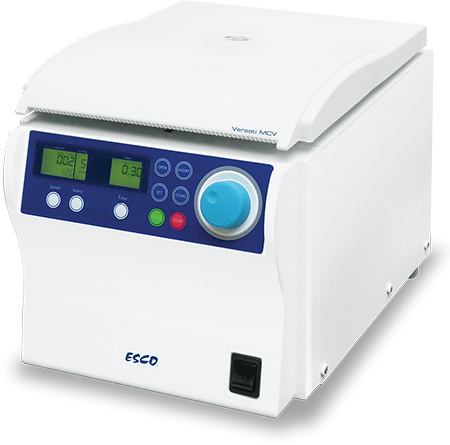 MCV-88
Versati™ Micro Ventilated Centrifuge
Specifications:
- Small capacity liquid samples
- Ambient temperature
- Audio and visual notification system
- Superior safety features
- Time-setting spin up to 99 hrs 59 min 10sec
- Dimensions (WxDxH): 280 x 389 x 304 mm


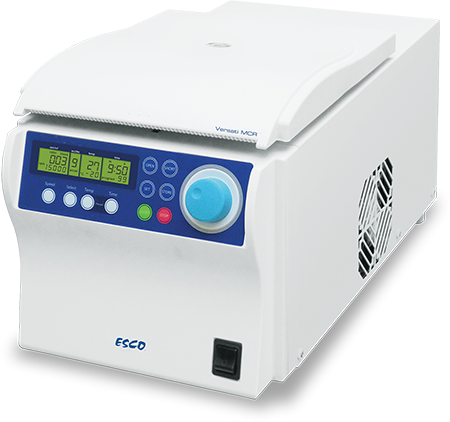 MCR-88
Versati™ Micro Refrigerated Centrifuge
Specifications:
- Small capacity liquid samples
- Refrigerated (temperature setting range: -20°C to 40°C)
- Audio and visual notification system
- Superior safety features
- Time-setting spin up to 99 hrs 59 min 10sec
- Dimensions (WxDxH): 280 x 563 x 294 mm
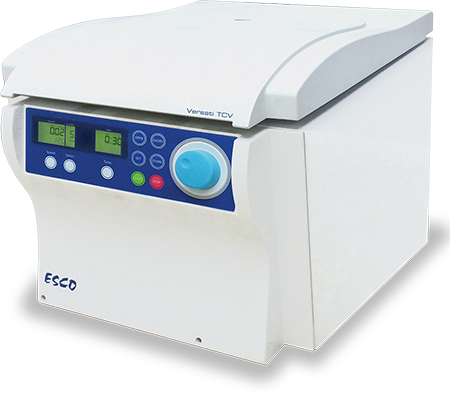 TCV-1500
Versati™ Tabletop Ventilated Centrifuge
Specifications:
- Large capacity liquid samples
- Ventilated temperature
- Audio and visual notification system
- Superior safety features
- Available fixed-angle and swing-bucket rotors
- Time-setting spin up to 99 hrs 59 min 10sec
- Dimensions (WxDxH): 438 x 532 x 374 mm
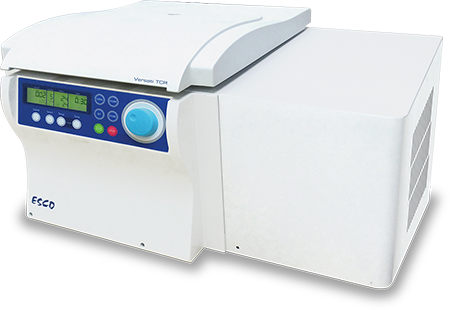 TCR-1500
Versati™ Tabletop Refrigerated Centrifuge
Specifications:
- Large capacity liquid samples
- Refrigerated (temperature setting range: -20°C to 40°C)
- Audio and visual notification system
- Superior safety features
- Available fixed-angle and swing-bucket rotors
- Dimensions (WxDxH): 715 x 528 x 373 mm
A centrifuge is a laboratory equipment used for the separation of heterogeneous mixtures or samples.
Centrifugation process can be employed to separate particles or macromolecules like cells, sub-cellular components, proteins, and nucleic acids. The particles are separated from a solution according to their size, shape, density, the viscosity of the medium, and rotor speed. Various separation technique can be done using a laboratory centrifuge. Basic applications include sample pelleting, sample separation, sedimentation and preparation, and blood/urine testing.
Centrifuge work by spinning the samples loaded in a rotor at high speed. It undergoes a centrifugation process which involves the use of centrifugal force for the separation of particles or macromolecules.
Centrifugal force is the apparent force used in centrifuge that draws a rotating body away from the center of rotation. The substance within the solution will be deposited to the bottom of the vessel thru the action of this force.
Swing-out/ swing-bucket, fixed-angle, microtiter plate rotor, PCR strip rotor, hematocrit rotor
No. Rotors have different maximum rcf/rpm. The fixed-angle rotors' maximum speed is 15000 rpm /21380 x g (for MCV & MCR), 15000 rpm/21382 x g (for TCV), and 16000 rpm/24,320 x g (for TCR). The automatic rotor recognition system is only available for tabletop centrifuges.
The external body of Versati™ Centrifuges are made of electro-galvanized steel with antimicrobial coating. Most of the rotors and rotor lids are made of aluminum. Transparent rotor lids, caps, rotors, and buckets/ adapters are made of polycarbonate or polypropylene.
No. As of now, the maximum capacity of Esco Versati™ tabletop centrifuge is 1500 ml only.
Yes, for hospital use in centrifugation of blood and urine, we have rotor (VST-ROT-014) for tabletop centrifuge models with a tube capacity of 30 x 15 ml, maximum speed at 4500 rpm.
In fixed-angle rotors, it is acceptable if the rotors are not filled totally with either tubes/adapters as long as the weight of the samples are equal and is placed symmetrically. But, in swing-bucket rotors, it is necessary to put all the buckets/adapters in the carriers and load the samples in the bucket/adapter diagonally with equal weight.
The refrigerated centrifuge is best used when handling temperature-sensitive samples such as DNAs, RNAs, proteins and blood.
Relative Centrifugal Force (RCF) is measured in force x gravity or g-force. It is the force exerted on the contents of the rotor, resulting from the revolutions of the rotor. On the other hand, Revolutions per Minute (RPM) is described as the speed of the centrifuge. The force applied to the contents varies by the size of the centrifuge rotor. RCF, not RPM, separates aqueous solutions in the centrifuge.
No, they may cause material damages and impair mechanical resistance.
The differences between micro centrifuge and tabletop centrifuge are the following:
1) Micro centrifuge can load a maximum volume of 88 ml while tabletop centrifuge can have a volume of up to 1500 ml.
2) The type of rotor that can be used for micro centrifuge is fixed-angled rotors only while for tabletop centrifuge, swing-out rotors and fixed-angled rotors can be used.
3) Tabletop centrifuge has a rotor auto-recognition system, no need for manual setting of rotor type. On the other hand, micro centrifuge does not have an automatic rotor detection system, so there is a need for manual setting of rotor type.