Cell counting is a critical step in many life science applications, including cell therapy, biopharmaceutical production, and advanced research. Accurate determination of cell concentration, size, and viability is essential to ensure reliable experimental outcomes and process consistency.
However, traditional manual counting methods are often time-consuming, subjective, and prone to variability, while conventional automated systems may struggle with complex cell types and conditions. Modern laboratories require a solution that is fast, accurate, and consistent across diverse applications.
Must-have features to consider:
- High accuracy and repeatability to ensure consistent and reliable results across different samples and operators.
- Independence from cell type and morphology to accurately analyze diverse and complex cell populations.
- Comprehensive data output including cell concentration, size distribution, and viability for deeper insights.
- Efficient and streamlined workflow to minimize manual steps and deliver faster time-to-result.
- Advanced data integrity and traceability to support secure data handling and regulatory compliance.
- Cost-efficient operation by reducing reliance on disposable consumables for long-term savings.
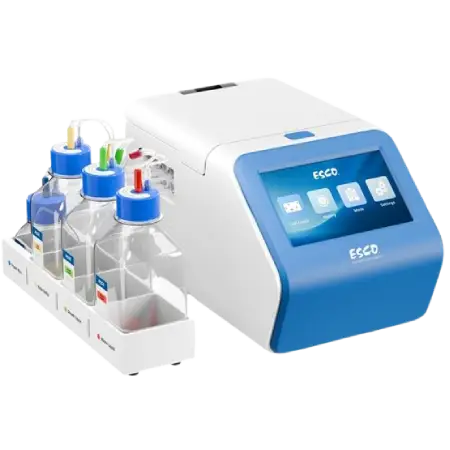
Engineered for precision and efficiency, the Esco ACC Series Automatic Cell Counting Analyzer delivers a next-generation solution for accurate and reliable cell analysis.By integrating the gold-standard Coulter principle with advanced image analysis, the ACC Series provides objective, repeatable, and high-accuracy results independent of cell type or operator variability. Designed for applications in cell therapy, biopharmaceuticals, and advanced research, it enables streamlined workflows, reduces operational costs, and supports compliance-ready data management.
 ACC-_
ACC-_
Esco ACC Series Automated Cell Counting Analyzer
Specifications:
• Coulter principle-based cell counting with electrical resistance detection
• Particle size detection down to 3 µm
• Coefficient of variation (CV) as low as <5% for high repeatability
• Integrated imaging for cell viability and morphology analysis (ACC-200/300)
• Reusable microfluidic counting chip, no disposable slides required
• Compatible with common buffers and media (e.g., PBS, RPMI-1640, DMEM).
A cell counter is used to measure cell concentration, size, and viability, which are essential parameters for ensuring accuracy and consistency in research, biopharmaceutical production, and cell therapy applications.
Manual counting is time-consuming and subject to operator variability, while automated cell counters provide faster, more consistent, and reproducible results.
The Coulter principle measures changes in electrical resistance as cells pass through a micro-aperture, enabling accurate determination of cell concentration and true cell volume.
Yes, it can analyze a wide range of cell types, including primary cells, immune cells, and mixed populations, regardless of shape or optical properties.
Yes, selected models support viability analysis using staining methods such as Trypan blue to differentiate live and dead cells.
High-performance systems can achieve a coefficient variation (CV) as low as <5%, ensuring excellent accuracy and repeatability.
Some systems use disposable slides, while others utilize reusable microfluidic chips to significantly reduce long-term consumable costs.
Results are typically available within seconds after sample loading, depending on the workflow and configuration.
Yes, advanced systems support features such as user access control, audit trails, and electronic signatures to comply with regulations like 21 CFR Part 11.
It is widely used in cell therapy, biopharmaceutical development, vaccine production, stem cell research, and general laboratory applications.