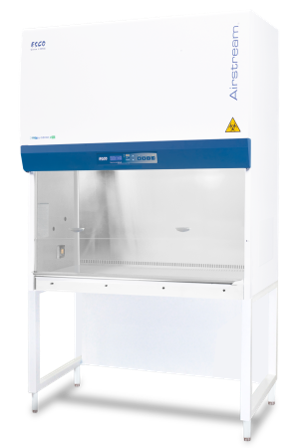
'n Biologiese veiligheidskas (BSC), ook bekend as 'n bioveiligheidskas, word hoofsaaklik gebruik vir die hantering van patogeniese biologiese monsters of vir toepassings wat 'n steriele werksone vereis. 'n Biologiese veiligheidskas skep 'n invloei en afwaartse vloei van lug wat beskerming vir die operateur bied. Die afwaartse lugvloei beweeg deur 'n ULPA/HEPA-filter en skep 'n ISO-klas 3-werksone om monsters teen die risiko van kruiskontaminasie te beskerm. Die uitlaatlug beweeg ook deur 'n ULPA/HEPA-filter voordat dit vrygestel word om die omgewing te beskerm.
Esco se biologiese veiligheidskaste het 'n wye reeks opsies, van werkbakke en sypaneelkonstruksie tot bykomstighede. Esco-BSC's is ontwerp met ergonomiese en energiebesparende kenmerke.
Om die biologiese veiligheidskas se optimale werkverrigting te waarborg, word dit volgens 2 standaarde getoets en geklassifiseer: EN 12469:2000 en NSF 49.

EN 12469
EN 12469: 2000 Biotegnologie - Prestasiekriteria vir mikrobiologiese veiligheidskaste is die nuwe geharmoniseerde Europese standaard vir mikrobiologiese veiligheidskaste, gepubliseer deur CEN, die Europese Komitee vir Standaardisering. Hierdie standaard klassifiseer BSC's in klas I, klas II en klas III.

NSF
NSF International (voorheen die National Sanitation Foundation) se program vir biologiese veiligheidskaste is gedurende die 1970's op versoek van die regulerende gemeenskap begin, insluitend die Sentrums vir Siektebeheer (CDC), Nasionale Institute van Gesondheid (NIH) en die Nasionale Kankerinstituut (NCI). Hierdie standaard klassifiseer biologiese veiligheidskaste van klas II verder volgens subtipes gebaseer op lugsirkulasie: klas II tipe A1, klas II tipe A2, klas II tipe B1 en klas II tipe B2.
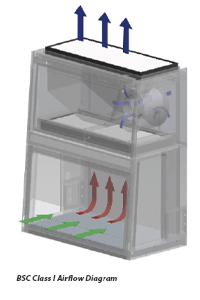
A Class I Biosafety cabinet protects the operator and the environment from exposure to biohazards. It does not prevent samples being handled in the cabinet from being exposed to contaminants that may be present in room air. Naturally, there is a possibility of cross-contamination that may affect experimental consistency. Consequently, the scope and application of Class I cabinets is limited, and it is largely considered obsolete.
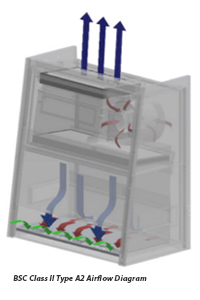
Class II Type A2
The Class II Type A2 biological safety cabinet is the most common Class II cabinet. It has a plenum from which 30% of air is exhausted, and 70% re-circulated to the work area as the downflow.
Stated from NSF/ ANSI 49:2010, both the Class II Type A1 and Type A2 must have the positively-pressurized contaminated plenum to be surrounded by negative pressure. In case there is a leakage on the positive plenum, the leaking aerosol will be pulled by the negative pressure back to the positive plenum, and it will not leak out.
In the A2 cabinet, about 70% of air from the positive plenum is recirculated as downflow, and the remaining 30% is discharged to the lab through the exhaust filter.
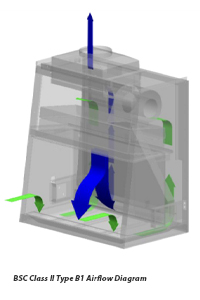
Class II Type B1
The Class II Type B1 biological safety cabinet has a common plenum from which 70% of air is exhausted, and 30% re-circulated to the work area as the downflow. This cabinet also has a dedicated exhaust feature that eliminates re-circulation when work is performed towards the back within the interior of the cabinet. Toxic chemicals employed as an adjunct to microbiological processes should only be allowed if they do not interfere with work when re-circulated in the downflow.
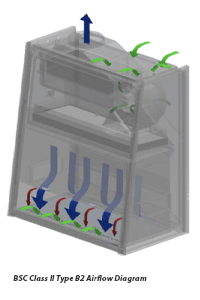
Class II Type B2
The Class II Type B2 biosafety cabinets are suitable for work with toxic chemicals employed as an adjunct to microbiological processes under all circumstances since no re-circulation occurs. In theory, Type B2 biological safety cabinets may be considered as the safest of all Class II BSCs since the total exhaust feature acts as a fail-safe in the event that the downflow and / or exhaust HEPA filtration systems cease to function normally. However, Class II Type B2 biosafety cabinets require large laboratory spaces due to their installation system and will require elaborate ducting works.
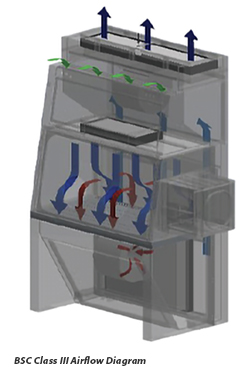
Class III Biological Safety Cabinets (BSCs) are designed for work involving microbiological agents assigned to Biosafety Levels 1, 2, 3, and 4, and are commonly specified for applications involving highly hazardous biological agents.
All work is performed through glove ports located at the front of the cabinet, ensuring complete physical separation between the operator and the work area. During normal operation, the cabinet maintains negative pressure relative to the surrounding environment. The cabinet is equipped with dual HEPA filtration on the exhaust system to provide an additional level of protection for personnel and the surrounding environment.
Volgens die WGO se Handleiding vir laboratoriumbioveiligheid, 4de uitgawe, word die werklike risiko van 'n gegewe scenario nie net beïnvloed deur die agens wat hanteer word nie, maar ook deur die prosedure wat uitgevoer word en die bevoegdheid van die laboratoriumpersoneel wat by die laboratoriumaktiwiteit betrokke is.
Risikogroepe is klassifikasies wat die relatiewe gevaar beskryf wat deur infeksieuse agense of toksiene in die laboratorium ingehou word.
Die Wêreldgesondheidsorganisasie (WGO) definieer die risikogroepe as:
- WGO-risikogroep 1 – geen of lae individuele en gemeenskapsrisiko
- WGO-risikogroep 2 – matige individuele risiko, lae gemeenskapsrisiko
- WGO-risikogroep 3 – hoë individuele risiko, lae gemeenskapsrisiko
- WGO-risikogroep 4 – hoë individuele en gemeenskapsrisiko
Biologiese veiligheidskaste word op 'n jaarlikse grondslag en/of wanneer hulle ook al verskuif word, hersertifiseer.
Volgens die WGO se Handleiding vir laboratoriumbioveiligheid, 3de uitgawe, is die meeste BSC's ontwerp om bedryf 24 h/dag toe te laat. Daar is bevind dat deurlopende bedryf help om die vlakke van stof en partikelmateriaal in die laboratorium te beheer.
Die geskatte raklewe van HEPA- of ULPA-filters is tot 10 jaar wanneer dit behoorlik geberg word.
Filters moet in hul oorspronklike verpakking gehou word en moet nie aan klamheid, oormatige hitte, koue of vinnig veranderende temperature blootgestel word nie. Hierdie filters kan tot 95% humiditeit verdra; enigiets hoër kan veroorsaak dat die filtermedia verstop raak en faal.