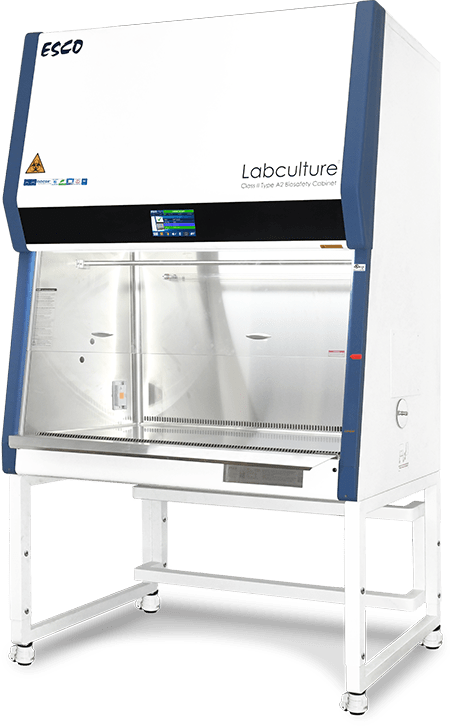
Un poste de sécurité microbiologique (PSM/BSC) est principalement utilisé pour manipuler des échantillons pathogènes ou pour des applications requérant une zone de travail stérile. Un PSM crée un flux d'air entrant et descendant assurant la protection du personnel. Le flux descendant traverse un filtre ULPA/HEPA pour créer une zone de travail ISO Classe 3 protégeant les échantillons des contaminations croisées. L'air extrait est également filtré par ULPA/HEPA avant d'être rejeté pour protéger l'environnement.
Les postes de sécurité biologique Esco offrent un large choix de plans de travail, parois latérales et accessoires avec une conception ergonomique et écoénergétique.
Pour garantir des performances optimales, ces équipements sont testés et classés selon 2 normes : EN 12469:2000 et NSF 49.

EN 12469
EN 12469: 2000 Biotechnologie - Critères de performance pour les postes de sécurité microbiologique est la nouvelle norme européenne harmonisée pour les postes de sécurité microbiologique, publiée par le CEN. Cette norme classe les PSM en Classe I, Classe II et Classe III.

NSF
Le programme pour postes de sécurité biologique de NSF International (anciennement National Sanitation Foundation) a été initié dans les années 1970 à la demande de la communauté réglementaire, notamment des CDC, NIH et NCI. Cette norme classe les PSM de Classe II selon la circulation d'air en sous-types : Classe II Type A1, Classe II Type A2, Classe II Type B1 et Classe II Type B2.
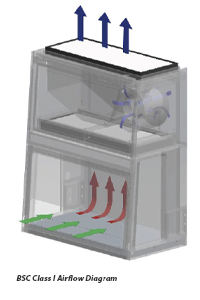
A Class I Biosafety cabinet protects the operator and the environment from exposure to biohazards. It does not prevent samples being handled in the cabinet from being exposed to contaminants that may be present in room air. Naturally, there is a possibility of cross-contamination that may affect experimental consistency. Consequently, the scope and application of Class I cabinets is limited, and it is largely considered obsolete.
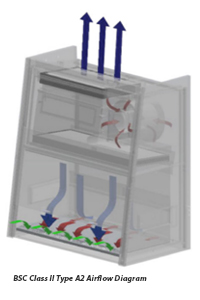
Class II Type A2
The Class II Type A2 biological safety cabinet is the most common Class II cabinet. It has a plenum from which 30% of air is exhausted, and 70% re-circulated to the work area as the downflow.
Stated from NSF/ ANSI 49:2010, both the Class II Type A1 and Type A2 must have the positively-pressurized contaminated plenum to be surrounded by negative pressure. In case there is a leakage on the positive plenum, the leaking aerosol will be pulled by the negative pressure back to the positive plenum, and it will not leak out.
In the A2 cabinet, about 70% of air from the positive plenum is recirculated as downflow, and the remaining 30% is discharged to the lab through the exhaust filter.
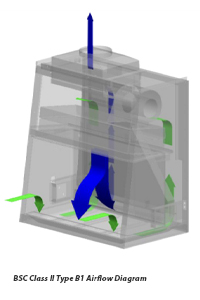
Class II Type B1
The Class II Type B1 biological safety cabinet has a common plenum from which 70% of air is exhausted, and 30% re-circulated to the work area as the downflow. This cabinet also has a dedicated exhaust feature that eliminates re-circulation when work is performed towards the back within the interior of the cabinet. Toxic chemicals employed as an adjunct to microbiological processes should only be allowed if they do not interfere with work when re-circulated in the downflow.
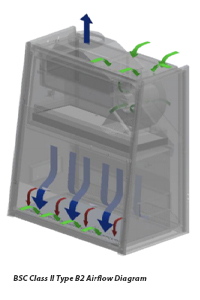
Class II Type B2
The Class II Type B2 biosafety cabinets are suitable for work with toxic chemicals employed as an adjunct to microbiological processes under all circumstances since no re-circulation occurs. In theory, Type B2 biological safety cabinets may be considered as the safest of all Class II BSCs since the total exhaust feature acts as a fail-safe in the event that the downflow and / or exhaust HEPA filtration systems cease to function normally. However, Class II Type B2 biosafety cabinets require large laboratory spaces due to their installation system and will require elaborate ducting works.
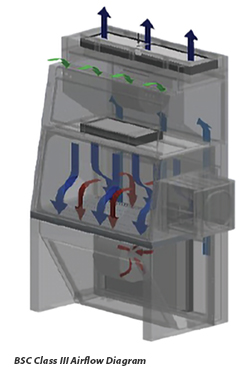
Class III biological safety cabinets are suitable for work with microbiological agents assigned to biosafety levels 1, 2, 3 and 4. They are frequently specified for work involving the most lethal biological hazards.
Work is performed through glove ports in the front of the cabinet. During routine operation, negative pressure relative to the ambient environment is maintained within the biosafety cabinet. This provides an additional fail-safe mechanism in case physical containment is compromised. Exhaust air is usually HEPA filtered and incinerated. Alternatively, double HEPA filtration with two filters in series may be utilized.
Selon le Manuel de biosécurité en laboratoire de l'OMS (4e édition), le risque réel d'un scénario donné dépend non seulement de l'agent manipulé, mais aussi de la procédure réalisée et des compétences du personnel de laboratoire participant à l'activité de laboratoire.
Les groupes de risque classent le danger relatif présenté par les agents infectieux ou les toxines en laboratoire.
L'Organisation mondiale de la santé (OMS) définit les groupes de risque comme suit :
- Groupe de risque OMS 1 : risque individuel et collectif faible ou nul
- Groupe de risque OMS 2 : risque individuel modéré, risque collectif faible
- Groupe de risque OMS 3 : risque individuel élevé, risque collectif faible
- Groupe de risque OMS 4 : risque individuel et collectif élevé
Les postes de sécurité microbiologique sont recertifiés chaque année et/ou lors de tout déplacement.
Selon le manuel de biosécurité en laboratoire de l'OMS (3e édition), la plupart des PSM sont conçus pour fonctionner 24 h/day. Le fonctionnement continu contribue à maîtriser les niveaux de poussières et particules dans le laboratoire.
La durée de conservation estimée des filtres HEPA ou ULPA est de 10 ans au maximum s'ils sont stockés convenablement.
Les filtres doivent être conservés dans leur emballage d'origine et protégés de l'humidité, de la chaleur excessive, du froid ou des variations thermiques rapides. Ils tolèrent jusqu'à 95% d'humidité ; au-delà, le média filtrant risque de se saturer et de faillir.