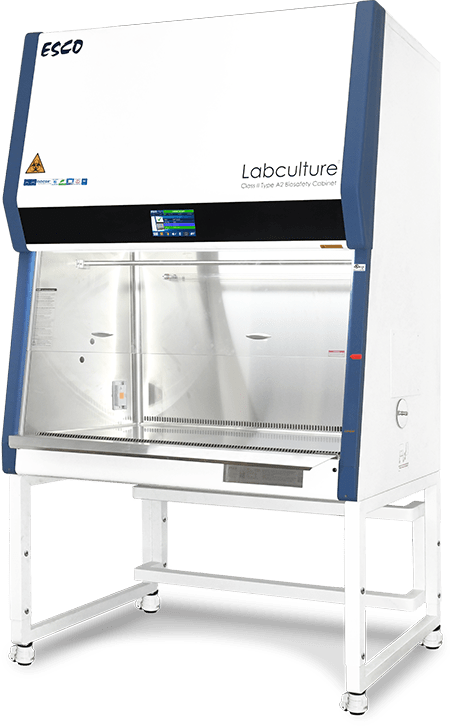
Una Cabina de Seguridad Biológica (BSC), también conocida como cabina de bioseguridad, se utiliza principalmente para manipular muestras biológicas patógenas o para aplicaciones que requieren una zona de trabajo estéril. Una Cabina de Seguridad Biológica genera flujo de aire de entrada y descendente que proporciona protección al operador. El aire de flujo descendente pasa a través de un filtro ULPA/HEPA y crea una zona de trabajo ISO Clase 3 para proteger las muestras del riesgo de contaminación cruzada. El aire extraído también pasa a través de un filtro ULPA/HEPA antes de liberarse para proteger el medio ambiente.
Las Cabinas de Seguridad Biológica Esco disponen de una amplia gama de opciones, desde bandejas de trabajo y construcción de paneles laterales hasta accesorios. Las BSC de Esco están diseñadas con características ergonómicas y de ahorro de energía.
Para garantizar el rendimiento óptimo de la Cabina de Seguridad Biológica, estas son probadas y clasificadas según 2 normas: EN 12469:2000 y NSF 49.

EN 12469
EN 12469: 2000 Biotecnología - Criterios de rendimiento para cabinas de seguridad microbiológica es la norma europea armonizada para cabinas de seguridad microbiológica, publicada por el CEN, el Comité Europeo de Normalización. Esta norma clasifica las BSC en Clase I, Clase II y Clase III.

NSF
El Programa de Cabinas de Seguridad Biológica de NSF International (anteriormente The National Sanitation Foundation) se inició durante la década de 1970 a petición de la comunidad reguladora, incluidos los Centros para el Control y la Prevención de Enfermedades (CDC), los Institutos Nacionales de Salud (NIH) y el Instituto Nacional del Cáncer (NCI). Esta norma clasifica además las Cabinas de Bioseguridad Clase II según subtipos basados en la circulación de aire: Clase II Tipo A1, Clase II Tipo A2, Clase II Tipo B1 y Clase II Tipo B2.
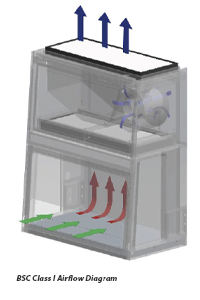
A Class I Biosafety cabinet protects the operator and the environment from exposure to biohazards. It does not prevent samples being handled in the cabinet from being exposed to contaminants that may be present in room air. Naturally, there is a possibility of cross-contamination that may affect experimental consistency. Consequently, the scope and application of Class I cabinets is limited, and it is largely considered obsolete.
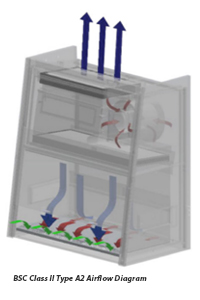
Class II Type A2
The Class II Type A2 biological safety cabinet is the most common Class II cabinet. It has a plenum from which 30% of air is exhausted, and 70% re-circulated to the work area as the downflow.
Stated from NSF/ ANSI 49:2010, both the Class II Type A1 and Type A2 must have the positively-pressurized contaminated plenum to be surrounded by negative pressure. In case there is a leakage on the positive plenum, the leaking aerosol will be pulled by the negative pressure back to the positive plenum, and it will not leak out.
In the A2 cabinet, about 70% of air from the positive plenum is recirculated as downflow, and the remaining 30% is discharged to the lab through the exhaust filter.
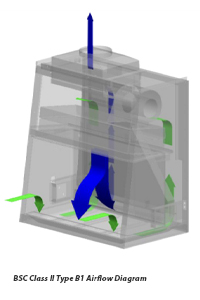
Class II Type B1
The Class II Type B1 biological safety cabinet has a common plenum from which 70% of air is exhausted, and 30% re-circulated to the work area as the downflow. This cabinet also has a dedicated exhaust feature that eliminates re-circulation when work is performed towards the back within the interior of the cabinet. Toxic chemicals employed as an adjunct to microbiological processes should only be allowed if they do not interfere with work when re-circulated in the downflow.
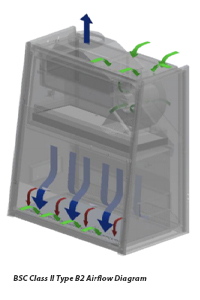
Class II Type B2
The Class II Type B2 biosafety cabinets are suitable for work with toxic chemicals employed as an adjunct to microbiological processes under all circumstances since no re-circulation occurs. In theory, Type B2 biological safety cabinets may be considered as the safest of all Class II BSCs since the total exhaust feature acts as a fail-safe in the event that the downflow and / or exhaust HEPA filtration systems cease to function normally. However, Class II Type B2 biosafety cabinets require large laboratory spaces due to their installation system and will require elaborate ducting works.
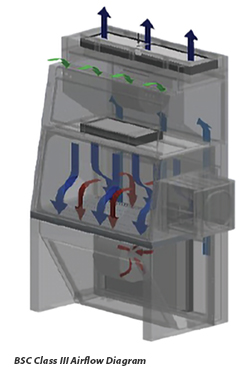
Class III biological safety cabinets are suitable for work with microbiological agents assigned to biosafety levels 1, 2, 3 and 4. They are frequently specified for work involving the most lethal biological hazards.
Work is performed through glove ports in the front of the cabinet. During routine operation, negative pressure relative to the ambient environment is maintained within the biosafety cabinet. This provides an additional fail-safe mechanism in case physical containment is compromised. Exhaust air is usually HEPA filtered and incinerated. Alternatively, double HEPA filtration with two filters in series may be utilized.
Según el Manual de Bioseguridad en el Laboratorio de la OMS, 4.ª edición, el riesgo real de un escenario determinado está influenciado no solo por el agente manipulado, sino también por el procedimiento realizado y la competencia del personal de laboratorio que participa en la actividad de laboratorio.
Los Grupos de Riesgo son clasificaciones que describen el peligro relativo planteado por agentes infecciosos o toxinas en el laboratorio.
La Organización Mundial de la Salud (OMS) define los grupos de riesgo como:
- Grupo de Riesgo 1 de la OMS: riesgo individual y comunitario nulo o bajo
- Grupo de Riesgo 2 de la OMS: riesgo individual moderado, riesgo comunitario bajo
- Grupo de Riesgo 3 de la OMS: riesgo individual alto, riesgo comunitario bajo
- Grupo de Riesgo 4 de la OMS: riesgo individual y comunitario alto
Las Cabinas de Seguridad Biológica se recertifican anualmente y/o cada vez que se trasladan.
Según el Manual de bioseguridad en el laboratorio de la OMS, 3.ª edición, la mayoría de las BSC están diseñadas para permitir un funcionamiento de 24 h/día. Se comprobó que el funcionamiento continuo ayuda a controlar los niveles de polvo y materiales particulados en el laboratorio.
La vida útil estimada de los filtros HEPA o ULPA es de hasta 10 años si se almacenan adecuadamente.
Los filtros deben conservarse en su embalaje original y no deben exponerse a la humedad, al calor o frío excesivos ni a cambios bruscos de temperatura. Estos filtros pueden tolerar hasta un 95% de humedad; valores superiores pueden provocar la obstrucción y fallo del medio filtrante.