What Makes an ISOIEC 17025-Accredited Calibration Different?
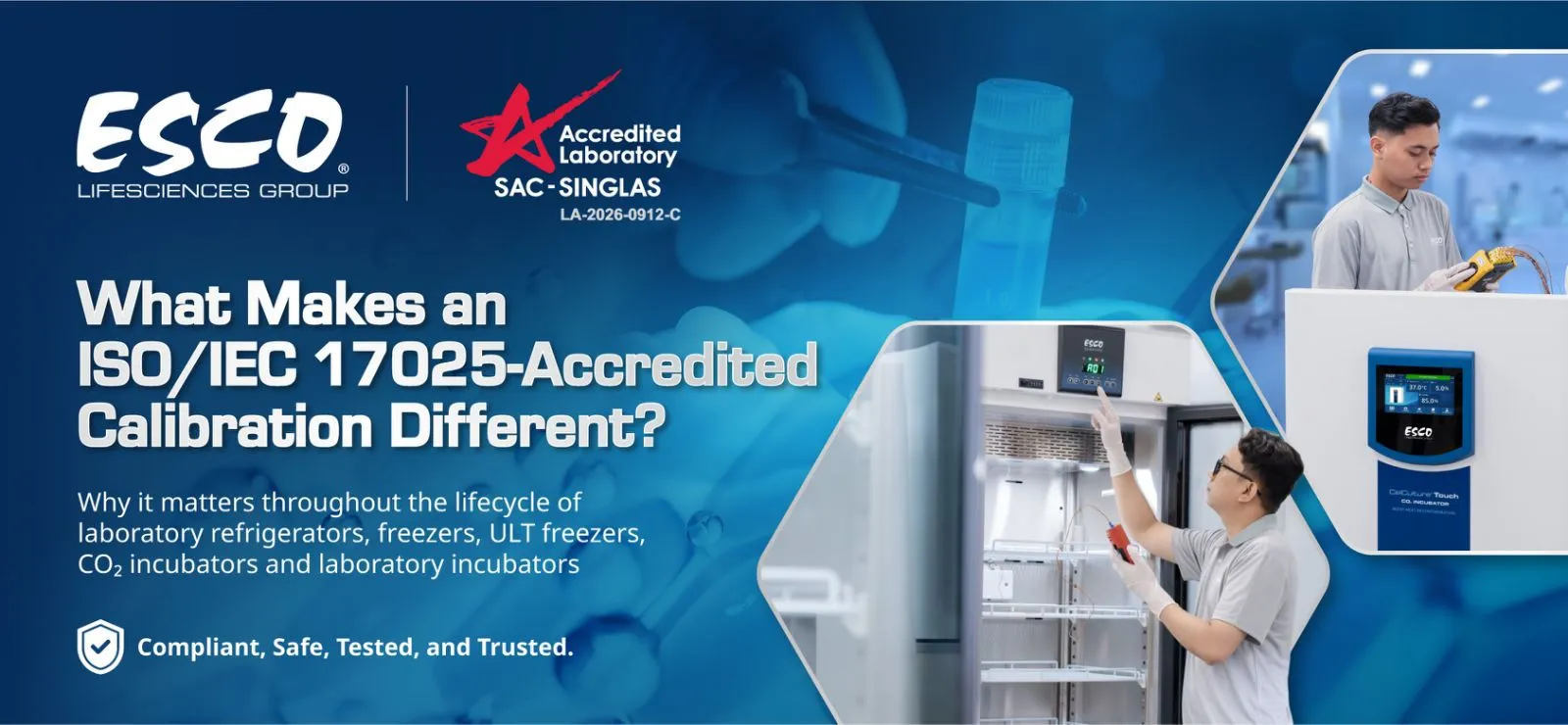
Why it matters throughout the lifecycle of laboratory refrigerators, freezers, ULT freezers, CO₂ incubators and laboratory incubators
Why calibration confidence matters
A thermostatic product can only protect what matters when its measured conditions can be trusted. Laboratory refrigerators, freezers, ULT freezers, CO₂ incubators and laboratory incubators are used to maintain controlled environments for temperature-sensitive materials, samples and laboratory processes.
Over time, sensors and measurement systems can drift. Routine commissioning, validation and calibration activities help verify performance. The key question is not simply whether a test was performed, but how much confidence the customer can place in the measurement result and in the system behind it.
That is where ISO/IEC 17025 accreditation adds value. A non-accredited calibration or validation service can still be technically sound, but ISO/IEC 17025 provides independent assessment of a laboratory’s competence for a defined accredited scope.
What is ISO/IEC 17025?
ISO/IEC 17025 is the international standard used to demonstrate the competence, impartiality and consistent operation of testing and calibration laboratories. Accreditation is granted for a defined scope of activities—not simply to every service a laboratory performs.
For accredited calibration activities, the laboratory’s personnel competence, methods, reference equipment, metrological traceability, measurement uncertainty and technical controls are independently assessed by an accreditation body.
For customers, this means an accredited calibration adds independent assurance around:
- Technical competence — the people, methods and equipment used for the accredited activity are formally assessed.
- Measurement traceability — the measurement result is linked through a documented traceability chain to recognised references.
- Measurement uncertainty — the result is reported together with the uncertainty associated with the measurement, where applicable to the accredited calibration.
At a glance: accredited vs non-accredited service
Both accredited and non-accredited providers can perform useful calibration or validation work. The difference is the level of independent assurance behind the measurement process.
| What matters | ISO/IEC 17025-accredited calibration | Standard / non-accredited calibration or validation |
|---|---|---|
| Independent oversight | Technical competence is independently assessed for the accredited scope | Quality and technical controls are determined by the provider and customer; not independently accredited for that activity |
| Personnel competence | Competence requirements are formally controlled and assessed | Can be well controlled, but external accreditation does not provide the same independent assurance |
| Measurement traceability | Traceability is formally established and assessed within the accredited system | Traceability may be available, depending on the provider and method |
| Measurement uncertainty | Evaluated and reported/controlled as required for the accredited calibration | May be evaluated or reported, depending on the service provided |
| Methods & equipment | Methods, reference equipment and technical controls are assessed within the accredited scope | Provider-defined controls; suitability should be reviewed against customer requirements |
| Certificate / report | Identifies the accredited calibration and applicable accreditation details | Standard service, commissioning, validation or calibration report/certificate |
| Decision-making | Where conformity statements are provided, decision rules are controlled within the accredited system | Acceptance approach depends on the provider’s procedure and customer requirements |
| Customer confidence | Provides independent evidence of technical competence for the accredited activity | Confidence depends on the provider’s demonstrated competence, controls and the customer’s acceptance criteria |
The right choice depends on the equipment, the criticality of what it protects, customer quality requirements and the level of independent evidence needed.
At a glance: accredited vs non-accredited service
ISO/IEC 17025-accredited calibration
- Independent assurance: competence for the accredited activity is assessed by an external accreditation body.
- Traceable, defensible measurement: traceability and measurement uncertainty are controlled and documented within the accredited system.
- Clearer evidence for quality systems: accredited results can provide stronger independent evidence where customers, auditors or internal procedures require it.
- Consistent technical controls: methods, reference standards, equipment and personnel are managed within the accredited scope.
- Lifecycle confidence: accredited recalibration can be incorporated into the equipment’s ongoing service and maintenance programme.
Standard / non-accredited calibration or validation
- Can still provide useful performance verification, depending on the provider’s methods, competence and quality controls.
- Can be suitable for routine checks, commissioning activities, interim verification or applications where accredited results are not required.
- Traceability, uncertainty evaluation and technical controls may still be present, but they are not independently accredited for that activity.
- Acceptance should therefore be based on the customer’s quality, regulatory and risk requirements.
Many laboratories use a combination of routine performance checks and accredited calibration at defined lifecycle points.
Why it matters for thermostatic equipment
| Equipment | What it helps protect | What the customer needs confidence in | Why accredited calibration can add value | Lifecycle support opportunity |
|---|---|---|---|---|
| Laboratory refrigerators | Temperature-sensitive reagents, samples and materials | Storage temperature, display indication and alarm-related measurements where in scope | Independent assurance around the calibration measurement process | Commissioning calibration → PM → periodic recalibration |
| Laboratory freezers | Frozen samples, reagents and laboratory materials | Storage temperature and related measurement performance | Traceable, uncertainty-controlled calibration results within scope | Commissioning calibration → PM → periodic recalibration |
| ULT freezers | High-value or irreplaceable materials stored at ultra-low temperature | Confidence in temperature measurement at critical low temperatures | Independent evidence of technical competence for the accredited measurement activity | Commissioning calibration → PM → periodic recalibration |
| CO2 incubators | Sensitive cultures and controlled growth environments | Temperature and CO2 measurement performance where included in scope | Greater confidence in the measurements used to verify the controlled environment | Commissioning calibration → PM → recalibration → technical support |
| Laboratory incubators | Temperature-controlled laboratory processes and samples | Temperature measurement and chamber performance | Accredited calibration provides independently assessed measurement assurance | Commissioning calibration → PM → periodic recalibration |
For thermostatic equipment, the job is not simply to display a temperature or CO₂ value. It is to maintain controlled conditions and give users confidence that those conditions are being measured reliably over time.
More than equipment: lifecycle support backed by accredited capability
Choosing a thermostatic product is not only a decision about specifications on day one. Over its operating life, the equipment may require installation, commissioning, calibration, preventive maintenance, recalibration and technical support. Esco brings these stages together through manufacturer-backed product knowledge and ISO/IEC 17025-accredited calibration capability for activities within the approved scope.
Why that matters
- Manufacturer-backed expertise: service personnel are trained on Esco equipment and supported by product knowledge, specifications and genuine parts.
- Accredited calibration capability: applicable calibration activities can be performed within Esco’s ISO/IEC 17025 accredited scope.
- Measurement confidence: accredited results are supported by controlled traceability and measurement uncertainty.
- Lifecycle continuity: installation, commissioning, preventive maintenance, recalibration and repair can be planned as one equipment support pathway.
- On-site support: where applicable, service can be performed at the customer site to reduce equipment movement and operational disruption.
- One support ecosystem: the product and the service capability behind it work together throughout the equipment lifecycle.
Compliant. Safe. Tested. Trusted.
Always have. Always will.
Confidence from installation. Support throughout the lifecycle.
Limited-time equipment promotion
In celebration of our newly accredited ISO/IEC 17025 calibration capability, customers purchasing selected Esco thermostatic equipment can receive a complimentary upgrade to ISO/IEC 17025-accredited commissioning calibration at no additional charge.
Applicable portfolio: selected Esco laboratory refrigerators, laboratory freezers, ULT freezers, CO₂ incubators and laboratory incubators, subject to local availability and the applicable accredited scope.
Promotion period: valid until March 2027 in Singapore, Vietnam, Indonesia and Malaysia. Contact your local Esco team for package details, eligibility and country-specific terms.
Frequently Asked Questions
1. What is ISO/IEC 17025 accredited calibration?
ISO/IEC 17025 is the international standard used to demonstrate the competence, impartiality and consistent operation of testing and calibration laboratories. In an accredited calibration, an accreditation body has independently assessed the laboratory’s personnel, methods, reference equipment, measurement traceability and measurement uncertainty for a defined scope of activities.
2. What is the difference between accredited and non-accredited calibration?
Both can provide useful performance verification. The difference is the level of independent assurance. In an ISO/IEC 17025 accredited calibration, an accreditation body has assessed the laboratory’s technical competence, traceability and uncertainty controls. In a non-accredited calibration, those controls are set by the provider and are not independently accredited for that activity.
3. Why does calibration matter for laboratory refrigerators, freezers and incubators?
Laboratory refrigerators, freezers, ULT freezers, CO₂ incubators and laboratory incubators protect temperature-sensitive samples, reagents and cultures. Sensors and measurement systems can drift over time, so calibration helps verify that the temperature and CO₂ conditions shown by the equipment can be trusted.
4. Is non-accredited calibration acceptable?
It can be. Non-accredited calibration or validation can suit routine checks, commissioning activities, interim verification, or applications where accredited results are not required. Whether it is acceptable depends on the customer’s quality, regulatory and risk requirements. Many laboratories combine routine performance checks with accredited calibration at defined points in the equipment lifecycle.
5. Does Esco offer ISO/IEC 17025 accredited calibration?
Yes. Esco provides ISO/IEC 17025 accredited calibration for activities within its approved accredited scope, performed by service personnel trained on Esco equipment. Calibration can be planned alongside installation, commissioning, preventive maintenance, recalibration and repair, and can be performed on-site where applicable.