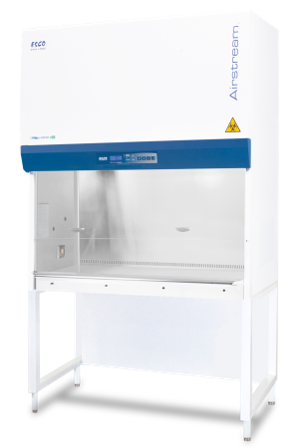
Kabinet Keamanan Hayati (BSC), yang juga dikenal sebagai Biosafety Cabinet, terutama digunakan untuk menangani sampel biologis patogen atau untuk aplikasi yang membutuhkan zona kerja steril. Kabinet keamanan hayati menciptakan aliran udara masuk (inflow) dan aliran ke bawah (downflow) yang memberikan perlindungan bagi operator. Aliran udara downflow melewati filter ULPA/HEPA dan menciptakan zona kerja ISO Kelas 3 untuk melindungi sampel dari risiko kontaminasi silang. Udara yang dibuang juga melewati filter ULPA/HEPA sebelum dilepaskan untuk melindungi lingkungan.
Kabinet biosafety Esco memiliki beragam pilihan mulai dari baki kerja, konstruksi panel samping, hingga aksesori. BSC Esco dirancang dengan fitur ergonomis dan hemat energi.
Untuk menjamin kinerja optimal kabinet keamanan hayati, unit-unit ini diuji dan diklasifikasikan berdasarkan 2 standar: EN 12469:2000 dan NSF 49.

EN 12469
EN 12469: 2000 Bioteknologi - Kriteria kinerja untuk kabinet keamanan mikrobiologis adalah standar Eropa yang diharmonisasi untuk kabinet keamanan mikrobiologis, diterbitkan oleh CEN, Komite Standardisasi Eropa. Standar ini mengklasifikasikan BSC menjadi Kelas I, Kelas II, dan Kelas III.

NSF
Program Kabinet Keamanan Hayati NSF International (sebelumnya The National Sanitation Foundation) diprakarsai pada tahun 1970-an atas permintaan komunitas regulasi, termasuk Pusat Pengendalian dan Pencegahan Penyakit (CDC), Institut Kesehatan Nasional (NIH), dan Institut Kanker Nasional (NCI). Standar ini lebih lanjut mengklasifikasikan Kabinet Keamanan Hayati Kelas II berdasarkan subtipe menurut sirkulasi udara: Kelas II Tipe A1, Kelas II Tipe A2, Kelas II Tipe B1, dan Kelas II Tipe B2.
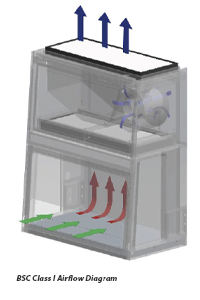
A Class I Biosafety cabinet protects the operator and the environment from exposure to biohazards. It does not prevent samples being handled in the cabinet from being exposed to contaminants that may be present in room air. Naturally, there is a possibility of cross-contamination that may affect experimental consistency. Consequently, the scope and application of Class I cabinets is limited, and it is largely considered obsolete.
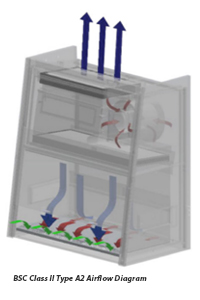
Class II Type A2
The Class II Type A2 biological safety cabinet is the most common Class II cabinet. It has a plenum from which 30% of air is exhausted, and 70% re-circulated to the work area as the downflow.
Stated from NSF/ ANSI 49:2010, both the Class II Type A1 and Type A2 must have the positively-pressurized contaminated plenum to be surrounded by negative pressure. In case there is a leakage on the positive plenum, the leaking aerosol will be pulled by the negative pressure back to the positive plenum, and it will not leak out.
In the A2 cabinet, about 70% of air from the positive plenum is recirculated as downflow, and the remaining 30% is discharged to the lab through the exhaust filter.
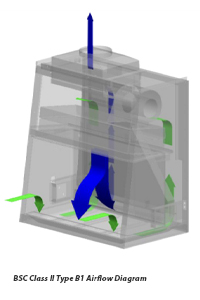
Class II Type B1
The Class II Type B1 biological safety cabinet has a common plenum from which 70% of air is exhausted, and 30% re-circulated to the work area as the downflow. This cabinet also has a dedicated exhaust feature that eliminates re-circulation when work is performed towards the back within the interior of the cabinet. Toxic chemicals employed as an adjunct to microbiological processes should only be allowed if they do not interfere with work when re-circulated in the downflow.
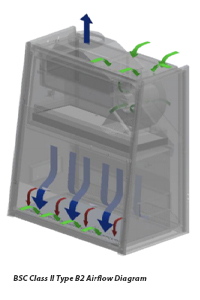
Class II Type B2
The Class II Type B2 biosafety cabinets are suitable for work with toxic chemicals employed as an adjunct to microbiological processes under all circumstances since no re-circulation occurs. In theory, Type B2 biological safety cabinets may be considered as the safest of all Class II BSCs since the total exhaust feature acts as a fail-safe in the event that the downflow and / or exhaust HEPA filtration systems cease to function normally. However, Class II Type B2 biosafety cabinets require large laboratory spaces due to their installation system and will require elaborate ducting works.
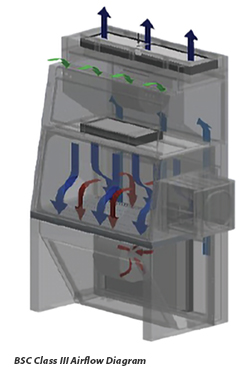
Class III biological safety cabinets are suitable for work with microbiological agents assigned to biosafety levels 1, 2, 3 and 4. They are frequently specified for work involving the most lethal biological hazards.
Work is performed through glove ports in the front of the cabinet. During routine operation, negative pressure relative to the ambient environment is maintained within the biosafety cabinet. This provides an additional fail-safe mechanism in case physical containment is compromised. Exhaust air is usually HEPA filtered and incinerated. Alternatively, double HEPA filtration with two filters in series may be utilized.
Menurut Manual Biosafety Laboratorium WHO Edisi ke-4, risiko aktual dari suatu skenario dipengaruhi tidak hanya oleh agen yang ditangani, tetapi juga oleh prosedur yang dilakukan dan kompetensi personel laboratorium yang terlibat dalam aktivitas laboratorium.
Kelompok Risiko adalah klasifikasi yang menggambarkan bahaya relatif yang ditimbulkan oleh agen infeksius atau racun di laboratorium.
Organisasi Kesehatan Dunia (WHO) mendefinisikan kelompok risiko sebagai:
- Kelompok Risiko WHO 1- tidak ada atau rendah risiko individu dan komunitas
- Kelompok Risiko WHO 2- risiko individu sedang, risiko komunitas rendah
- Kelompok Risiko WHO 3- risiko individu tinggi, risiko komunitas rendah
- Kelompok Risiko WHO 4- risiko individu dan komunitas tinggi
Kabinet Keamanan Hayati disertifikasi ulang setiap tahun dan/atau setiap kali dipindahkan.
Menurut Manual biosafety laboratorium WHO, edisi ke-3, sebagian besar BSC dirancang untuk memungkinkan operasi 24 jam/hari. Ditemukan bahwa operasi berkelanjutan membantu mengontrol tingkat debu dan bahan partikulat di laboratorium.
Perkiraan masa simpan filter HEPA atau ULPA adalah hingga 10 tahun jika disimpan dengan benar.
Filter harus disimpan dalam kemasan aslinya dan tidak boleh terkena kelembapan, panas berlebih, dingin, atau perubahan suhu yang cepat. Filter ini dapat mentolerir kelembapan hingga 95%; nilai yang lebih tinggi dapat menyebabkan media filter tersumbat dan gagal.