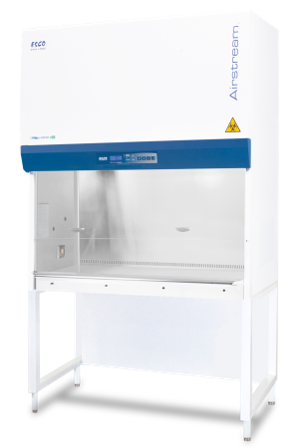
생물안전작업대(BSC)는 병원성 생물학적 시료를 취급하거나 무균 작업 구역이 요구되는 실험에 주로 사용됩니다. 유입 기류와 하강 기류를 형성하여 작업자를 안전하게 보호합니다. 하강 기류는 ULPA/HEPA 필터를 통과하여 ISO Class 3 청정 작업 영역을 형성함으로써 교차 오염 위험으로부터 시료를 보호합니다. 배출 공기 역시 ULPA/HEPA 필터를 통과한 후 배출되어 환경을 보호합니다.
Esco 생물안전작업대는 작업대 트레이, 측면 패널 구조 및 다양한 액세서리 옵션을 제공하며 인체공학적이고 에너지 절약형 구조로 설계되었습니다.
최적의 성능을 보장하기 위해 EN 12469:2000 및 NSF 49, 이 2가지 표준에 따라 성능 시험 및 분류가 이루어집니다.

EN 12469
EN 12469: 2000 생명공학 - 미생물 안전작업대 성능 기준은 유럽표준화위원회(CEN)에서 제정한 유럽 통일 규격입니다. 이 규격은 BSC를 Class I, Class II 및 Class III로 분류합니다.

NSF
NSF International(구 미국위생협회) 생물안전작업대 인증 프로그램은 1970년대 질병통제예방센터(CDC), 국립보건원(NIH), 국립암연구소(NCI)의 요청으로 시작되었습니다. Class II 생물안전작업대를 공기 순환 방식에 따라 Class II Type A1, 타입 A2, 타입 B1 및 타입 B2 서브타입으로 분류합니다.
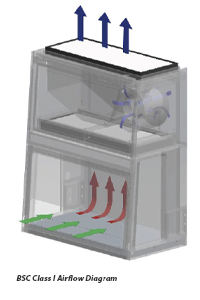
A Class I Biosafety cabinet protects the operator and the environment from exposure to biohazards. It does not prevent samples being handled in the cabinet from being exposed to contaminants that may be present in room air. Naturally, there is a possibility of cross-contamination that may affect experimental consistency. Consequently, the scope and application of Class I cabinets is limited, and it is largely considered obsolete.
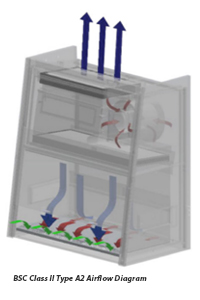
Class II Type A2
The Class II Type A2 biological safety cabinet is the most common Class II cabinet. It has a plenum from which 30% of air is exhausted, and 70% re-circulated to the work area as the downflow.
Stated from NSF/ ANSI 49:2010, both the Class II Type A1 and Type A2 must have the positively-pressurized contaminated plenum to be surrounded by negative pressure. In case there is a leakage on the positive plenum, the leaking aerosol will be pulled by the negative pressure back to the positive plenum, and it will not leak out.
In the A2 cabinet, about 70% of air from the positive plenum is recirculated as downflow, and the remaining 30% is discharged to the lab through the exhaust filter.
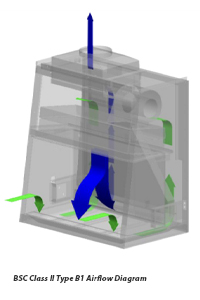
Class II Type B1
The Class II Type B1 biological safety cabinet has a common plenum from which 70% of air is exhausted, and 30% re-circulated to the work area as the downflow. This cabinet also has a dedicated exhaust feature that eliminates re-circulation when work is performed towards the back within the interior of the cabinet. Toxic chemicals employed as an adjunct to microbiological processes should only be allowed if they do not interfere with work when re-circulated in the downflow.
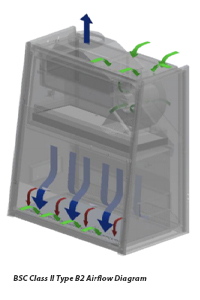
Class II Type B2
The Class II Type B2 biosafety cabinets are suitable for work with toxic chemicals employed as an adjunct to microbiological processes under all circumstances since no re-circulation occurs. In theory, Type B2 biological safety cabinets may be considered as the safest of all Class II BSCs since the total exhaust feature acts as a fail-safe in the event that the downflow and / or exhaust HEPA filtration systems cease to function normally. However, Class II Type B2 biosafety cabinets require large laboratory spaces due to their installation system and will require elaborate ducting works.
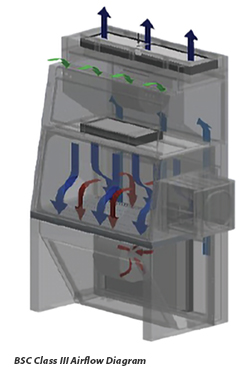
Class III biological safety cabinets are suitable for work with microbiological agents assigned to biosafety levels 1, 2, 3 and 4. They are frequently specified for work involving the most lethal biological hazards.
Work is performed through glove ports in the front of the cabinet. During routine operation, negative pressure relative to the ambient environment is maintained within the biosafety cabinet. This provides an additional fail-safe mechanism in case physical containment is compromised. Exhaust air is usually HEPA filtered and incinerated. Alternatively, double HEPA filtration with two filters in series may be utilized.
WHO 실험실 생물안전 매뉴얼 4판에 따르면, 주어진 상황의 실제 위험도는 취급하는 병원체뿐만 아니라 수행되는 실험 절차와 해당 실험실 활동에 참여하는 실험실 작업자의 숙련도에 따라서도 달라집니다.
위험군은 실험실 내 감염성 병원체나 독소가 미치는 상대적 위험도를 분류한 기준입니다.
세계보건기구(WHO)는 위험군을 다음과 같이 정의합니다:
- WHO 위험군 1: 개인 및 지역사회 위험 없음 또는 극히 낮음
- WHO 위험군 2: 중간 정도의 개인 위험, 낮은 지역사회 위험
- WHO 위험군 3: 높은 개인 위험, 낮은 지역사회 위험
- WHO 위험군 4: 높은 개인 위험 및 높은 지역사회 위험
생물안전작업대는 매년 정기적으로 재인증을 받아야 하며, 장비를 이동 재설치할 때마다 반드시 재인증을 받아야 합니다.
WHO 실험실 생물안전 매뉴얼 3판에 따르면 대부분의 BSC는 하루 24시간(24 h/day) 연속 가동이 가능하도록 설계되어 있습니다. 연속 가동은 실험실 내 미세먼지 및 분진 제어에 도움이 됩니다.
적절하게 보관할 경우 HEPA 또는 ULPA 필터의 예상 보관 수명은 최대 10년입니다.
필터는 원 포장 상태로 보관해야 하며 습기, 과도한 열, 냉기 또는 급격한 온도 변화에 노출되지 않아야 합니다. 최대 95% 습도까지 견딜 수 있으며 그 이상의 습도는 필터 미디어 손상을 유발할 수 있습니다.