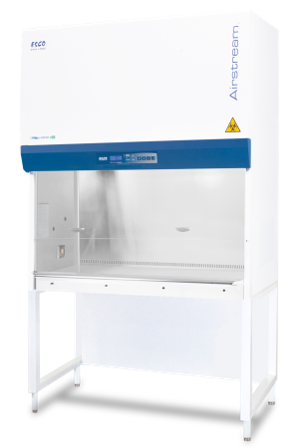
Бокс биологической безопасности (БББ), также известный как бокс биобезопасности, применяется для работы с патогенными биологическими агентами или в процессах, требующих стерильной среды. Бокс создает входящий воздушный поток и нисходящий ламинарный поток для защиты оператора. Нисходящий поток очищается через ULPA/HEPA-фильтр, формируя чистую зону класса ISO 3 для предотвращения перекрестной контаминации. Вытяжной воздух также очищается ULPA/HEPA-фильтром перед выбросом.
Боксы биобезопасности Esco предлагают широкий выбор рабочих поверхностей, конструкций боковых панелей и опций с эргономичным дизайном.
Для обеспечения надежной работы боксы тестируются и классифицируются по 2 стандартам: EN 12469:2000 и NSF 49.

EN 12469
EN 12469: 2000 «Биотехнология. Технические критерии эффективности для боксов микробиологической безопасности» представляет собой гармонизированный европейский стандарт, опубликованный Европейским комитетом по стандартизации CEN. Данный стандарт классифицирует боксы на Класс I, Класс II и Класс III.

NSF
Программа сертификации оборудования биологической безопасности NSF International (ранее National Sanitation Foundation) была инициирована в 1970-х годах по запросу профильных регуляторных органов, включая CDC, NIH и NCI. Этот стандарт детально классифицирует боксы II класса по подтипам распределения воздушных потоков: класс II тип A1, класс II тип A2, класс II тип B1 и класс II тип B2.
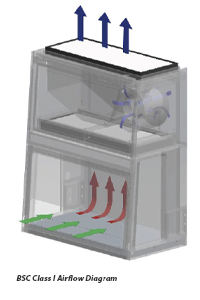
A Class I Biosafety cabinet protects the operator and the environment from exposure to biohazards. It does not prevent samples being handled in the cabinet from being exposed to contaminants that may be present in room air. Naturally, there is a possibility of cross-contamination that may affect experimental consistency. Consequently, the scope and application of Class I cabinets is limited, and it is largely considered obsolete.
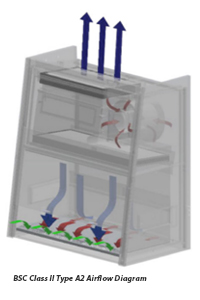
Class II Type A2
The Class II Type A2 biological safety cabinet is the most common Class II cabinet. It has a plenum from which 30% of air is exhausted, and 70% re-circulated to the work area as the downflow.
Stated from NSF/ ANSI 49:2010, both the Class II Type A1 and Type A2 must have the positively-pressurized contaminated plenum to be surrounded by negative pressure. In case there is a leakage on the positive plenum, the leaking aerosol will be pulled by the negative pressure back to the positive plenum, and it will not leak out.
In the A2 cabinet, about 70% of air from the positive plenum is recirculated as downflow, and the remaining 30% is discharged to the lab through the exhaust filter.
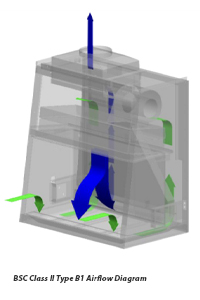
Class II Type B1
The Class II Type B1 biological safety cabinet has a common plenum from which 70% of air is exhausted, and 30% re-circulated to the work area as the downflow. This cabinet also has a dedicated exhaust feature that eliminates re-circulation when work is performed towards the back within the interior of the cabinet. Toxic chemicals employed as an adjunct to microbiological processes should only be allowed if they do not interfere with work when re-circulated in the downflow.
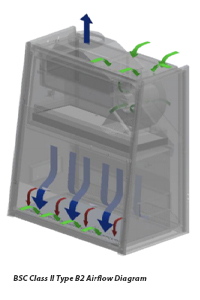
Class II Type B2
The Class II Type B2 biosafety cabinets are suitable for work with toxic chemicals employed as an adjunct to microbiological processes under all circumstances since no re-circulation occurs. In theory, Type B2 biological safety cabinets may be considered as the safest of all Class II BSCs since the total exhaust feature acts as a fail-safe in the event that the downflow and / or exhaust HEPA filtration systems cease to function normally. However, Class II Type B2 biosafety cabinets require large laboratory spaces due to their installation system and will require elaborate ducting works.
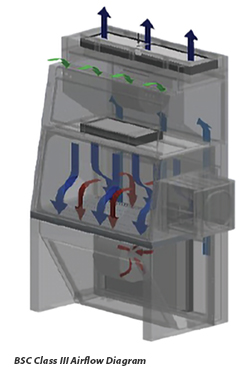
Class III biological safety cabinets are suitable for work with microbiological agents assigned to biosafety levels 1, 2, 3 and 4. They are frequently specified for work involving the most lethal biological hazards.
Work is performed through glove ports in the front of the cabinet. During routine operation, negative pressure relative to the ambient environment is maintained within the biosafety cabinet. This provides an additional fail-safe mechanism in case physical containment is compromised. Exhaust air is usually HEPA filtered and incinerated. Alternatively, double HEPA filtration with two filters in series may be utilized.
Согласно Практическому руководству по биологической безопасности в лабораториях ВОЗ (4-е издание), фактический риск конкретного сценария определяется не только обрабатываемым агентом, но также выполняемой процедурой и компетентностью лабораторного персонала, участвующего в лабораторной деятельности.
Группы риска — это классификация относительной опасности инфекционных агентов или токсинов в лаборатории.
Всемирная организация здравоохранения (ВОЗ) выделяет следующие группы риска:
- Группа риска ВОЗ 1: индивидуальный и общественный риск отсутствует или крайне низок
- Группа риска ВОЗ 2: умеренный индивидуальный риск, низкий общественный риск
- Группа риска ВОЗ 3: высокий индивидуальный риск, низкий общественный риск
- Группа риска ВОЗ 4: высокий индивидуальный и высокий общественный риск
Боксы биологической безопасности подлежат ежегодной периодической валидации и проверке, а также обязательной повторной проверке после каждого перемещения.
Согласно руководству ВОЗ по биобезопасности в лабораториях (3-е издание), большинство БББ рассчитаны на круглосуточную эксплуатацию (24 h/day). Непрерывная работа способствует контролю уровня пыли и аэрозолей.
Ориентировочный срок хранения фильтров HEPA или ULPA при правильных условиях составляет до 10 лет.
Фильтры следует хранить в оригинальной заводской упаковке, защищая от сырости, высоких и низких температур и резких перепадов. Фильтры выдерживают влажность до 95%; превышение этого значения ведет к повреждению фильтрующего материала.