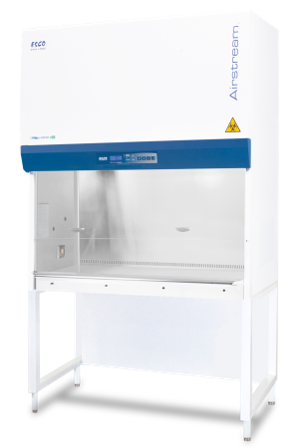
生物安全柜(BSC)主要用于处理致病性生物样本或需要无菌工作区的实验操作。生物安全柜通过形成流入气流和垂直下降气流来保护操作人员。下降气流经过ULPA/HEPA过滤器,形成ISO 3级洁净工作区,保护样品免受交叉污染。排放的空气在排出前也经过ULPA/HEPA过滤器过滤,以保护外部环境。
Esco生物安全柜提供丰富的配置选项,从工作台面、侧壁结构到多样化配件。Esco生物安全柜融入了人机工程学与节能设计。
为保证生物安全柜的最佳性能,所有设备均依据2项标准进行检测与分类:EN 12469:2000与NSF 49。

EN 12469
EN 12469: 2000《生物技术 - 微生物安全柜的性能要求》是由欧洲标准化委员会(CEN)发布的微生物安全柜统一欧洲标准。该标准将生物安全柜分为I级(Class I)、II级(Class II)和III级(Class III)。

NSF
NSF International(原美国国家卫生基金会)生物安全柜标准项目于1970年代在疾病控制与预防中心(CDC)、美国国立卫生研究院(NIH)和国家癌症研究所(NCI)等监管机构的要求下启动。该标准根据气流循环方式将II级生物安全柜进一步细分为:II级A1型、II级A2型、II级B1型和II级B2型。
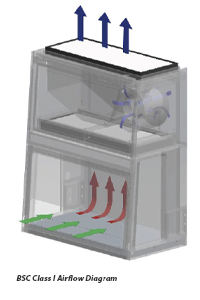
A Class I Biosafety cabinet protects the operator and the environment from exposure to biohazards. It does not prevent samples being handled in the cabinet from being exposed to contaminants that may be present in room air. Naturally, there is a possibility of cross-contamination that may affect experimental consistency. Consequently, the scope and application of Class I cabinets is limited, and it is largely considered obsolete.
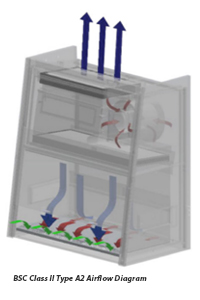
Class II Type A2
The Class II Type A2 biological safety cabinet is the most common Class II cabinet. It has a plenum from which 30% of air is exhausted, and 70% re-circulated to the work area as the downflow.
Stated from NSF/ ANSI 49:2010, both the Class II Type A1 and Type A2 must have the positively-pressurized contaminated plenum to be surrounded by negative pressure. In case there is a leakage on the positive plenum, the leaking aerosol will be pulled by the negative pressure back to the positive plenum, and it will not leak out.
In the A2 cabinet, about 70% of air from the positive plenum is recirculated as downflow, and the remaining 30% is discharged to the lab through the exhaust filter.
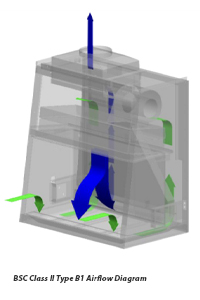
Class II Type B1
The Class II Type B1 biological safety cabinet has a common plenum from which 70% of air is exhausted, and 30% re-circulated to the work area as the downflow. This cabinet also has a dedicated exhaust feature that eliminates re-circulation when work is performed towards the back within the interior of the cabinet. Toxic chemicals employed as an adjunct to microbiological processes should only be allowed if they do not interfere with work when re-circulated in the downflow.
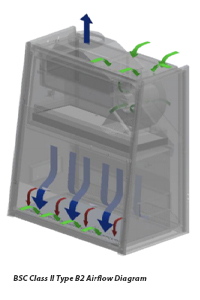
Class II Type B2
The Class II Type B2 biosafety cabinets are suitable for work with toxic chemicals employed as an adjunct to microbiological processes under all circumstances since no re-circulation occurs. In theory, Type B2 biological safety cabinets may be considered as the safest of all Class II BSCs since the total exhaust feature acts as a fail-safe in the event that the downflow and / or exhaust HEPA filtration systems cease to function normally. However, Class II Type B2 biosafety cabinets require large laboratory spaces due to their installation system and will require elaborate ducting works.
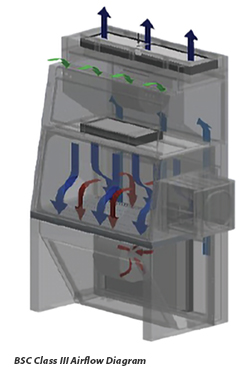
Class III biological safety cabinets are suitable for work with microbiological agents assigned to biosafety levels 1, 2, 3 and 4. They are frequently specified for work involving the most lethal biological hazards.
Work is performed through glove ports in the front of the cabinet. During routine operation, negative pressure relative to the ambient environment is maintained within the biosafety cabinet. This provides an additional fail-safe mechanism in case physical containment is compromised. Exhaust air is usually HEPA filtered and incinerated. Alternatively, double HEPA filtration with two filters in series may be utilized.
根据世界卫生组织(WHO)《实验室生物安全手册》(第4版),特定操作场景的实际风险不仅取决于所处理的生物因子本身,还取决于所开展的具体实验规程以及实验人员的专业操作胜任力。
危险度等级是对实验室中感染性病原体或毒素所构成的相对危害进行的分类。
世界卫生组织(WHO)将危险度等级定义如下:
- WHO 1级危险度:个体和群体风险极低或无风险
- WHO 2级危险度:个体风险中等,群体传播风险低
- WHO 3级危险度:个体风险高,群体传播风险低
- WHO 4级危险度:个体和群体风险均极高
生物安全柜应每年进行一次定期重新认证检测,并且在设备移动位置后必须重新进行认证检测。
根据世界卫生组织(WHO)《实验室生物安全手册》(第3版),大多数生物安全柜被设计为允许每天24小时(24 h/day)连续运行。研究表明,连续运行有助于持续控制实验室内的粉尘和颗粒物水平。
在妥善储存的条件下,HEPA或ULPA过滤器的预估储存寿命最长可达10年。
过滤器应保存在原包装中,不得暴露于潮湿、过热、极寒或急剧变化的温度环境中。这些过滤器最高可耐受95%的湿度;高于此湿度可能导致滤材堵塞损坏并失效。